Essentials

Tuesday, 25 May 2021

Rethinking the Top 10 Overrated Cartoons?

Back in the early 2010s. I used to participate in a number of memes found on DeviantArt. I would use certain templates to offer my thoughts and opinions in my spare time. One of these included a list of 'overrated cartoons', in which I would talk about animated series' I felt didn't deserve the praise or attention they received. 

Since I made this list, I've learned to be more thoughtful and constructive with my criticisms. So I thought why not look back on this list and re-evaluate these choices, and see how my opinions hold up. I'm not doing this to sound like a Mr Enter wannabe, but rather take a look at each animated series with a perspective that offers a much fair assessment. Oh, and in case you're wondering, I'm not going to do the same with my list of 'underrated cartoons'; as I don't think there's much I can change there (and I've already talked about most of the choices enough times on this blog.


10.
 
South Park
It figures that one of the choices for this list would be a controversial pick, as these 4 boys in the cutout Colorado town are no strangers to controversy. Chances are, many children were (and still are) prevented from watching 'South Park', and I was one of those children. That may be a contributing factor in my opinion at the time. When I was at the age to watch it, and any time I did; it just wasn't to my taste. I am aware of how popular and significant it is to many people, but the truth of the matter is that I could not stand how vulgar, crass, and shocking it can be. I'm no expert on comedy, but it's my understanding that being gory, shocking and disgusting doesn't make your humour funny. But if the joke is funny, and just so happens to use gore and disgust, so be it. But they're definitely times where it can go too far. The characters and the way they treat each other give off this overly pessimistic and bitter vibe in how it portrays our sociality. One notable example is Cartman, this fat devil child has done acts that are so despicable and conniving that would make even Dennis the Menace, Wayne Cramp and Shin Chan appalled. Now, I don't have a problem with jerk protagonists if they A. suffer the consequences of their actions, or B. learn the error of their ways and try to improve themselves. Not all characters have to set examples of virtue all the time. Even if that was the case, that still wouldn't make him any more likeable. Maybe seeing these kid characters committing these acts and getting into crazy situations was edgy in the 90s, but I seldom ever been attached to any of these characters or find them endearing. 

But you know, I learned something one day; from what I saw from South Park and from further research, I came to understand that significance. The show uses vulgar shock humour and hyperboyles to convey social commentary on current events and social issues. Even back then, I acknowledged that the writers manage to inject their message into their comedy and storytelling. This is a show that's not afraid to point out the naked truth and give a statement on both sides of any issue; no matter what it is. It has the nerve to address such difficult topics without fear of who gets offended in the process. The reason why it's animated in such a crude minimalist style so to keep these stories topical. It's something I can respect, more so than I like. Another nice thing I can say about it is that admittedly, Trey Parker really does put the right inflections when voicing these characters; which might add to why these lines of dialogue are quotable among fans. So, do I regret putting this show on the list? No. Despite its significance, if I'm not entertained by it or find enlightenment in it; then I could care less about it. For me, I feel these characters feel more like mouthpieces for the writers to voice their opinions than seemingly weaving such ideals into the plot. Maybe it's because I'm personally more drawn to characters that become fleshed out in multi-layered settings as opposed to satire. Are these messages really sincere when you have to sit through such profanity? But when I say I don't like the show, I'm not just referring to the episodes that are hated among fans. Even if society becomes much more chaotic as time goes on, it's unlikely that Trey and Matt are going to run out of ideas anytime soon. But for me personally, it is staying on the list. As long as our world doesn't become as crazy or extreme as South Park's, I hope people won't take this opinion out of proportion.

9. Johnny Test
I don't know how many people remember, but Johnny Test had a certain bad rep. Johnny Test takes the concept of 'Dexter's Lab', swapped the genders, split the genius into two and added a talking dog (definitely not the most original premise for sure). Although it tried to make itself different from that show, it simply wasn't enough. Many people criticized the cartoon for its drop in quality, not that it was ever great at the start, but its first season looked masterful compared to the mutation it became. The animation switched to Flash, the characters became less likeable, the stories would make less sense, the deliveries became much more breakneck and furthermore; it relayed heavily on the 'whip crack' sound effect. But what made this show so hated is that at the time, it stayed on the air for far too long, despite all this criticism. Probably because it was so cheap to produce. But was all the backlash towards Johnny Test warranted, or was it overblown?

I don't understand why I even considered putting this show on the list if it received so much backlash.
That's what I thought as well, but back then I thought there had to have been an audience for it if more episodes were being made. I think I just wanted an excuse to talk about my frustration for it, that I put it there anyway. I must say, I was inclined to agree with the criticism towards 'Johnny Test' as I was also sick of it back then (Even though I just easily ignored it). But even though it eventually stopped, I will say that it's still a far cry from being among the rites of good cartoons. On some level, the concept of Johnny using his sister's inventions to achieve his personal goals and go on many adventures could work. I mean it was a common premise for children's cartoons back when I was young. The show likes to experiment with certain scenarios and ideas, but like the sisters' works, the execution result in them not being as fun as it could potentially be. As it went on, it would take less time to take a breathe and let the action and comedy set in. Whatever plot-line it tries to do falls flat or has already been done better in other tv shows of its kind. Plot points just come off as contrived and not well thought out. As it's a dialogue-heavy show, the comedy is based on gag humour; particularly in its use of self-referential remarks. While a percentage of it is very sophomoric. I can accept extreme/gross-out humour, but it needs to be balanced out with strong storytelling. A majority of it is on par with the last 2 seasons of 'Fairly Odd Parents'. 
At its best, the show can have a point. These "good" episodes aren't the most original story-wise, but there are plot points that can serve a particular purpose or moral. Give it some credit, it had an episode that foretold how badly Youtube stars like Fred and Annoying Orange would translate to film/tv. 

Most of the characters fall into the category of archetypes, with maybe a few key differences. The main characters like Johnny and his sisters use these devices and each other for their own personal gain. Johnny is essentially a blank slate, meant to be radical and relatable to the target audience; his attitude comes off stubbornly persistent throughout each episode. Whereas I can empathise with Timmy Turner and his plights, Johnny is just arrogant and self-entitled. While Susan and Mary are one and the same, as the young prodigies who offer scientific exposition; and whose main motivation is to attract their crush. (Who barely knows they exist). Though they each have their different viewpoints, it gets too common for their experiments to go awry. Dukey acts as the supposed voice of reason (no pun intended), he offers Johnny his own worldly advice. He can actually be alright with his remarks, support and how he has to knock sense into Johnny. But he can also be easily roped into these antics. As it's more episodic, there're rarely any moments of these characters growing and developing from these episodes. Any time it looks like it's trying to be sincere, it's just playing itself for laughs. I'm not asking for these characters to be totally complex, but more development from them would have helped this show in the long run.


If there's any other positive aspect I can say about it, it would be the voice acting. I mean it's hard to tell with the obnoxious amount of whip sounds and times where the characters yell their lines, but I admit it has talented people on board. I feel like they tried to give the best performances with the material they were given. But just because an actor/actress has been in good projects doesn't mean they haven't been in bad ones as well. Voice acting aside, the rest of the production values are like junk food for the senses. It's obvious that the animation budget was cut in half, with how artificial the movements and oversaturated the backgrounds became. There are moments where the keyframing doesn't look so stiff, this shift was not very seamless. The main reason why I think it doesn't take a breath because practically every scene contains a simultaneous music cue or sound effect to compensate for the lacklustre movements. But the animation is only the least of this show's problems compared to how contrived the stories became. Maybe younger viewers who haven't seen these plots before might find enjoyment in these flashy images and sound effects, but there's only so much that they can resonate with. Older audiences might not be so appreciative of it. But I know children are smart enough to realise what they like and dislike, I knew I realised this cartoon became half-assed and cheesy the older I became. That's something I bet anyone didn't see coming at all.


So I do understand why Johnny Test got on people's nerves, and why people were sick and tired of seeing over-saturated at the time. It was definitely an experiment that got botched due to less restraint. While it certainly wasn't necessary for it to have lasted as long as it did, it definitely didn't need to be on this list in the first place. For that, it gets to be off the list. Looking back, I probably should have put Johnny Bravo or Powerpuff Girls there instead (I make no apologies). But I don't think there's a need to try it over again with a reboot, just shut down this operation for goodness sake. And while you're at it, focus on continuing shows that deserve a proper ending. Or you know, make new stuff.


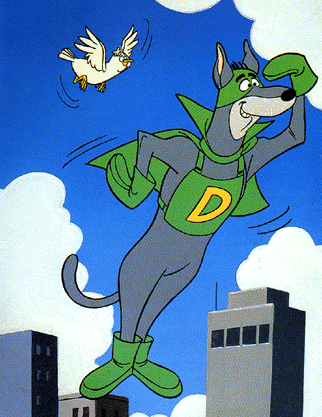
8. Dynomutt Dog Wonder
Many regard Hanna Barbera as pioneers in television animation, but let's not kid ourselves; their library may have had a few stinkers to their name. In my opinion, the 1970s was where the company took a decline in quality. They relied too heavily on trying to milk the success of 'Scooby-Doo' by making copies of it, there were very few shows from that era that are as well remembered as they were in their heyday. Most of their output would have these hero hound protagonists, and Dynomutt Dog Wonder was one of them. For those who aren't as knowledgeable with HB, the premise revolves around rich socialite art dealer Radley Crown and his mechanical dog as they protect Big City as the crime-fighting duo, The Blue Falcon and Dynomutt. If you're a millennial like myself, you probably know about Dynomutt Dog Wonder from the crossover it made with Dexter's Lab. If you've seen every superhero duo, you've pretty much seen this show. With its kooky villains, one-liners and diabolical schemes that involve some kind of device. It doesn't do much to advance the crime-fighting genre at the time, except for adding much more comedy. Unfortunately, it barely triumphs at both action or humour. 


Dynomutt acts as the comic relief, he's able to be more expressive and spontaneous with how he moves his robotic limbs. Like a certain mystery-solving hound, his expressions are designed to appear much goofy compared to the more realistic human characters. Each gag involves the Dog Blunder (the show's words not mine) screwing up any endeavour he and the Falcon undertake. I mean, just because it's in his character to mess up, make problems worse or cause frustration; it doesn't make him a good character. Captain Flamingo was more diligent than this so-called "hero hound". Now having the main character cause comical mess-ups, much to the misfortune of others could be funny depending on the context. But the show expects us to root for him. I mean he's not the worse example of a superhero causing more problems than solves, he can make an effort to follow through with a plan sooner or later; but his errors/malfunctions are not loveable as he or the writers may think. Dynomutt having all these high-tech gadgets built into his body isn't all that special when you can get that from the likes of 'The Million Dollar Man'. Also, not to disrespect Frank Welker, but the voice he provides for Dynomutt sound oddly similar to Bullwinkle, it doesn't help that Dynomutt spouting lines that aren't the least bit clever. Blue Falcon is the serious strategist of the duo, with him being the moral centre who comes up with the plans. It's usually him who fixes Dynomutt's efforts and thwart the villains. As a hero I can't find him compelling, ironically I feel a show about an art dealer would make a much more interesting concept. Each episode shows him having to put up with Dynomutt's antics, though some of his dry remarks towards Dynomutt can be pretty funny. 


Speaking of which, I'm not particularly a fan of how it mixes humour with action, I don't know if it's the swift pacing, or the actors' delivery but it's much akin to what HB was doing with their mystery-solving cash-cow. As the show didn't have a high budget, the angles used in the more action-oriented scenes aren't as dynamic as they're supposed to be. I can understand that Hanna Barbera didn't have the budget to achieve that, but even as someone who's still trying to improve on developing compositions, how it used here is basic by today's standards. Since the 90s, it has taken much more to pull off a superhero comedy. Whatever, Dynomutt is just not to my taste, I can only see people enjoying this as a goofy guilty pleasure, but if you're a die-hard HB fan; you might find this up your alley. But if you're not into the campy, lighthearted heroic duos, and you have a low tolerance for clumsy sidekicks; I just don't think it's worth going out of your way to watch it. As someone who doesn't care for the main characters or these comical perils, it remains on the list. Like an old machine, I see more of Dynomutt's faults with retrospect.

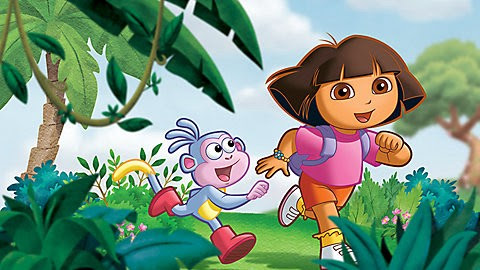
7. Dora the Explorer
Full disclosure, I wasn't in the show's intended audience when I first discovered it. I mean I still caught wind of it, but I was becoming less interested in "kid's shows" at that time. But that doesn't excuse it from any form of criticism. The show follows a young Latina girl Dora and her monkey sidekick Boots as they travel to various locations searching for mystical objects; while coming across various colourful characters. Such as their talking map, their talking backpack, Dora's cousin Diego and a dastardly fox who always attempts to swipe any important object. But it's also an interactive show, where Dora and Boots would break the fourth wall in order to ask the viewers to find the locations and help solve the puzzles. Instead of using the fourth wall for comedic gag purposes, Dora asks the audience to partake in her quests; even making them do a series of random exercises to achieve them. Can you see what the problem with this cartoon is?

The show is so incredibly formulaic, no matter where Dora and Boots end up it always follows the same story beats, but it seldom ever tries to mix up or subvert the formula. The locations and adventures that Dora embarks on could lead to promising and fantastical concepts; the problem is the road the writers take. Dora would constantly put the plot on hold to look for the destination or remind the viewers, to much older viewers these pauses can get awkward. Everyone speaks the catchphrases in a manner that gets old and irritating fast. The way these characters talk in these bizarre inflections feels so condescending that I agree with my younger self that it's too much to bear. I understand that Dora is intended for little children, but even shows of this type still need to have effort and thought put into them. Each journey keeps the same simple structure in order for children to follow, it showcases these obstacles at their level to help form their puzzle-solving skills. 'Lost' this is definitely not! In a show like this, you have to keep the concept simple in order to build on from. The problem is that the story is put aside to focus on the puzzles, rather than fitting them into a cohesive story. But the songs keep beating you over the head trying to remind you where they have to go. The visuals are made to be more child friendly, with its use of bright colours as well as the pastel textures in the backgrounds. The polished designs and movements fit the criteria you expect for an animated series. It's just that it looks all overly saccharine and safe, that it's also a little too much. It certainly used its growing budget to use. When they reach its climax, it sometimes plays it off in a mundane way, to teach/showcase social skills rather than applying these actions to the theme of the setting. 


In terms of educational value, it's questionable if it even works on children. I doubt the methods Dora
shows would be applicable in real-life situations. Except for maybe picking up on some Spanish. As someone who's half Latino, it's good that it tries to have ethnic characters, I mean it's not like it's done in a way that reflects badly on the writers/creators. Unlike other main protagonists in which you can put yourself in their place as you follow them, this show encourages them to partake in the puzzles with them than learning from their actions. They use the interactions as a ploy to engage child viewers, instead of showing the characters figuring these obstacles out. Dora's role is to interact with the viewers to see if they can spot the object; and offer exposition, even though she and Boots can find it for themselves. Boots pretty much does the same thing, only his dialogue and enthusiasm can be even more puerile. I fail to find the charm in these catchphrases or recurring gags. All this time they interact and let the audience respond could've been used for plot/character development. Sooner or later, children will realise that they can't communicate with the characters. Swiper is pretty much the amount of conflict the show gets. Not only do these characters need to be aware of their location, but they don't show self-awareness of the plot or the tone. 


For many years, this along with Spongebob was Nickelodeon's cash cow. It was loco how popular it was. While this may have intrigued smaller children, this only seemed to irritate much older viewers. Despite all the publicity it had, I feel the series has gained the reputation it deserves, from critics at least. Whereas other children's programmes have their own strange but unique charm and morals that are still enduring. This might explain their staying power and why these remain to be remembered fondly, Dora is just seen as a has-been nowadays. The last time Dora was ever relevant was with its live-action film adaption, and no I'm not talking about the CollegeHumor video; there was a legitimate big-budget film to cap off the series. By the way, if you have seen the Dora movie, could you let me know how it was? I don't know if it could be any worse than the Fairly Odd Movies or 'The Last Airbender'. While I wouldn't say it's a good show, the criticism from educators and those outside its key age demographic is justified. Those who did outgrow Dora will look back and laugh at how stupid it could be, while others will go on to explore other adventure-based stories. Which is enough for this show to find its way off the list. Maybe its target audience could find something enjoyable in Dora's adventures, older viewers will only find them annoying. TenĂ­a que decir eso.


6. Jonny Quest
We now move on to the other cartoon with the main character called Jonny (though my mistake is that I spelt the name incorrectly the first time). Anyway, Jonny Quest follows the adventures of a young boy and a group consisting of his father Dr Quest, Race Bannon, Hadji and their canine Bandit. Each episode would have this team exploring the globe to discover its unusual mysteries and phenomena, while also having to battle many oddities and foes such as the evil Dr Zin. But don't worry these adventures are relatively more robust than our last entry. Out of all the Hanna Barbera cartoons of the 60s, I've never cared for Jonny Quest. Whether it be the 90s version or the 60s version, it just never left an impact on me. But that's not to say I have anything against the action/adventure genre, it's just that I've never been a fan of ones of this show's variety. When I would watch old HB shows at a young age, I was mostly spoilt on their stylized sitcoms. But when I did see shows like 'Jonny Quest', I wasn't able to follow them. As time went by though, I was also so busy with reading classic literature, I never bothered to get into these adventures. But for variety's sake, I suppose I can give HB credit for branching out by doing something other than just comedy. But the mystery remains, how do these adventures fare?

In each episode, we see Jonny and the gang rumble with international terrorists, unethical professors or ferocious creatures. Like with Johnny Test and Dora the Explorer I have nothing against the set up of the locations Jonny embarks on, but mostly it's the direction the show takes that doesn't cut it for me. I'm all for adventure stories if the characters we follow are compelling and the locations are intriguing. Well, the show certainly embraces its influence of radio serials and espionage; but its incorporation of other genres like science fiction and spy fiction doesn't draw me into Jonny's missions. The approach JQ takes is that it's set during a Cold War setting, many of these settings and futuristic devices are the typical action show standard, but these machines I don't find to be designed or function that uniquely. The stories don't affect me like the literary classics of the adventure genre, it's what they entail and how they're presented that may not matter to you as it would to me. After all, 'Treasure Planet' is the same Robert Louis Stevenson story, just in an alternative setting. And I wouldn't say the action scenes are poorly done, it's just that if I'm not captivated with the story or characters; then they don't mean anything to me. Before Jonny, HB cartoons were focused on slapstick humour, but whenever people would come in contact with explosives or whatever fatality comes their way. It really infers they're hurt and/or killed, though it doesn't show them bleeding. You really have to be in a certain mindset to handle the amount of action, but I feel it's tamed enough that younger viewers nowadays could watch it just fine. You can read into its details and discuss how much of an impact it had on you or animated programming. But at the end of the day, I'm not a big fan of it.

When you get down to it, these characters could be seen as archetypes. Jonny is the intrepid, young
adventurer who usually behaves enthusiastically when aiding his father and Race or outwitting foes, he tends to give the more humourous lines as any plucky child character would. Dr Quest usually offers his own wisdom and technical jargon. I'll admit he can be a sensible strategist and offer witty lines. Race is the rugged agent that offers exposition for any mission and makes observations at any given situation, but he can also kick heinie. He can also act as a role model for Jonny. Hadji processes mystical abilities as well as judo, even if they're just parlour tricks. As cautious as he may be, he can also be persuaded into these adventures like Jonny. I give it credit that he was the earliest TV show character in a turban to not be portrayed as a villain. Though that doesn't excuse the other racial stereotypes. The villains can pose a real threat, but what made previous HB antagonists so memorable was that they had over the top personalities. I don't see that with the villains here. I couldn't recall their motivations here. Bandit's facial expressions and movements lighten up the intense, edgier tone. At least he doesn't speak in an irritating voice like a certain great dane. The character's actions can serve the plot as well as a jocular one-liner. I mean their dynamic is there, I just don't find them that interesting, and I wish to see more compelling characters in their roles.   

Art style-wise, I could see what they were going for; they tried to evoke the illusion of a comic book brought to life. But that's something the limited animation budget at the time couldn't justify. Contrast and compare this to the only action cartoon many were aware of 'Clutch Cargo'; which (I kid you not) super-imposed live-action lips onto still images. Because it was made on such a shoestring budget, people nowadays see it as a relic of the past. (Though I could see how some find the effects awkwardly charming). That's probably the same reason why millennials don't take 'Space Ghost' or 'Birdman' seriously anymore, for how they've been parodied on Adult Swim. I'm not saying this looks just as uncanny, nor do I expect the company's output to look like a moving painting. But the dark shading on the characters or the colour palette isn't particularly my cup of tea. I acknowledge HB were daring enough to take on a much intense direction, while still employing their own trademarks for the effects. But the fact HB made shows like Johnny Quest opened up the possibilities for them to take on other genres and styles.

However just because something is influential or innovative, doesn't mean it can always lead to good things. They'll always be a ton of imitators who either don't understand what made that thing work in the first place, or they'll be in favour of over saturating the market with the same idea, while other genres will be overlooked. They're plenty of adventure shows that are done in different styles and genres for people to explore, it's just in terms of aesthetics, JQ doesn't appeal to me personally. The same can be said for many of HB's iconic animated shows. You may think I sound grossly biased, but JQ is just not for me. If Jonny's mission was to convince HB to make more serious programming, I can't say it didn't succeed in that regard. But to get off this list, well, I'm leaving it there. I also cannot lie, a show's legacy cannot equate to its overall quality. But still, the only mystery that's yet to solve is how Jonny's name should be spelt? But I'm going off-topic there.


5. Jabberjaw
Remember how I said Hanna Barbera relied on cashing in on the success of 'Scooby-Doo' with similar copycat shows; this was one of them. For those who haven't discovered Jabberjaw, it basically follows a similar setup as SD, with the team of teens and their anthropomorphic companion who encounter an assorted number of antagonists (Though they don't have their own intense closeup). Only this time, they're in a band and the setting is this underwater civilization. On their own, these concepts could be interesting on paper; it would take a lot to pull them off together. My problem with Jabberjaw is how this mash-up is executed. I remember watching this show quite a bit as a child, but it never left an impact on me like a certain undersea sponge. The plots follow the same rhythm with very few attempts to add different strokes. It always involves Jabberjaw and the gang clashing with intergalactic villains, thus messing up their schemes to take over the ocean floor. It squanders a setting that could lead to plenty of promise in favour of the cheese factor. It thinks just because it has a compound premise, that it can excuse the writers from putting a focus on the right elements. I've seen villain schemes that can be convoluted, but the setups here aren't even accurate. For example; there's a villain called 'Coldfinger', shouldn't the obvious Bond reference be 'Octo-pussy'? The humour is very much dialogue-driven as well, it also comes from Jabberjaw adapting himself to various forms and objects, using his abilities to get his friends out of hot water. It's like they combined the humour of 'Squiddly Diddly' and the setting of 'Sealab 2020' (Sealab 2020, so much for foresight). I didn't laugh out loud at this, I can see a set up for a joke. Aside from a snide expression, the humour isn't a barrel of laughs. A group of musical teens battling aquatic foes just isn't as cool as it may sound. I'm not asking for the show to be overly serious or tackle melodramatic turmoil, but it makes for silly, ludicrous, ultra corny vibes.


It's really the characters that keep the premise from working. Jabberjaw is the band's pet/drummer whose goofy antics always act as the catalyst to these stories, his main character conflict is that he has trouble being accepted among other humans and sea life; being a predator and all. He was made to appear and behave friendly, heroic and goofy that even people who're afraid of sharks can like him. The problem with how he's written to spout irritating noises, yeah I get that his voice is based on Curly from 'The Three Stooges'; but the sounds that come out of him can get really old and annoying fast. Whenever he tries to act tough, I can't help but be reminded of Scrappy-Doo. Biff is the pretty boy of the group, all that's known about him is that he's the leader who plans out these gigs. Shelly is the vain, stuck up member with a massive ego; who believes she's more important than the others. She can be a real sea cow. Basically, she hates Jabber's guts and is shown to not get along with him; except for the times where she shows her mutual respect for him. Frankly, I could not stand to be with each of them. Bubbles is the ditzy member with a high-pitched voice, so she's the 'Cat Valentine' of the show. Clamhead is Jabber's human companion who constantly says these jibberish phases. This Jughead wannabe has uttered as many incomprehensible remarks as much as Shaggy as said 'zoinks'. And that's the main problem with these main characters, it's their dialogue. The writers made these teens and Jabberjaw's dialogue comprised of ocean-related slang, to appeal to the youth at the time. The register that they exchange becomes grating really fast. It takes a linguist even, to pull off this dialogue in a manner similar to 'Klingon'. I feel Spongebob did a much better job at ocean-related wordplay. I've seen better variations of these characters in one way or another, they're one-note; for lack of a better term. Quirky character traits are fine sparingly, which Jabberjaw doesn't know the meaning of.


This was made in the 70s, So I'm not going to expect the animation quality to be fluid and elegant, but
barnacles is the movement stilted and limited! The poses aren't particularly dynamic or interesting enough to compensate for this. I've seen cut-out animation that looks more believable than how the characters move here. Basic angles may have their place, but it can get tiring to see this little variation for each episode. The character design looks like it's taken straight out of "Archie's Comics'. The backgrounds aren't especially detailed, the underwater cities that our gang tour around aren't very interesting to look at. The colour palette consists of shades of blue with dull beige colours. They would have looked more interesting if there was more ancient architecture mixed with futuristic design, there might be a few glass domes that reflect that (no pun intended). But as it is, the settings are just generic sci-fi scenery. The songs that play during fight or chase sequences have very little to do with the episode plots, nor do they advance them. The style and melodies are typical of pop-rock from that time. 


I would complain about how similar it is to 'Scooby Doo', as it seems like it's interconnected with it even. The 1970s had so many bizarre trends, yet I could never understand the appeal of these SD wannabees. For which is worse, the offender or the one influenced by the offender? I mean Spongebob tends to borrow traits from 'Ren and Stimpy' (even having some of the same crew members), but it still managed to make itself different from that show. It really goes how far animated comedies have come, and how far they shouldn't go. With Jonny Quest, it opened the doors for TV animation to tell more complex stories, but instead, HB chose to exploit the same cheesy formula. It would take them a decade to get out of their doldrums. There's a place for poppy, cheery, squeaky clean, non-threatening entertainment. There's just not enough to make these characters or their setting enthralling. Sure there are pop groups I still have a soft spot for, but this embodies the traits of pop that don't hold up. I still think the overall reception is still giving it too much credit. There's certainly worse stuff out there than this, but I still wouldn't recommend it. This shark and his group remain on the list for sure, sorry Jabberjaw but you still don't deserve any of my respect.

4. Captain Planet and the Planeteers

If you've never been raised in 90s culture, I'll explain briefly the way this show can. Captain Planet and the Planeteers was Ted Turner's attempt to raise awareness for eco concerns the only way he knew how. When the earth is consumed by pollution and climate change, Gaia a Mother Nature-esque Earth goddess cannot take it anymore. So she sends 5 magical rings to these 5 teens of different nationalities, with their powers combined they summon the environmentally themed super-being known as CAPTAIN PLANET! Sorry there. In the 21st Century, Captain Planet has been criticised by the likes of the Nostalgia Critic for how corny, lame and how heavily it corporates its messages. I must ask, are environmental messages in cartoons so inherently bad? Every story has some form of a lesson, but I'm a firm believer that it's the story that should take main priority. I'd much prefer if it intertwined it's message into the stories. Even stories that don't go out of their way to preach lessons, do have a sense of morality. And Captain Planet was the earliest to present such topics at the time. Each episode follows a template, in which the planeteers go around the world to protect the environment from the polluting baddies and their schemes. It illustrates the subject matter as these action-packed missions, as to make it seem appealing to impressionable young viewers. In principle, the concept of a group of youth protagonists battling against an evil tyranny or force with a specific theme could work. In fact, the idea of each member having powers to control the natural elements is a concept that has worked well in other shows. I actually don't have a problem with the idea of Ma-Ti using 'heart' as a power, I like the idea of using compassion and feeling as an asset. But the show doesn't just tackle environmental issues, it also touches upon prejudice, diseases, drug abuse and other heavy topics that were yet to be tackled back then. If there are episodes that can raise an eyebrow, it would the ones that are about overpopulation, which definitely doesn't fly by these days (if you're aware of what I mean). It does try to convey the disastrous effect pollution and deforestation can have, as well as the brevity of these situations with intense drama. I agree it can come off as heavy-handed in its approach, in your face even. But when it's not well informed, that's when its heavy handiness gets ham-fisted as well and not always universal. In terms of visuals, the character movements are a tad more natural/believable and less stilted (except when they don't). The shading on their designs is the standard of action-oriented cartoons at the time. Most of the shots can rely on close-ups that can get awkward.  


I'm all for these team members having different nationalities, so long as they have strong, memorable personalities and their own personal motivations and backstory to fight for a cause. In this case, the
planeteers' purpose is to project values through their dialogue and character growth. Wheeler is the cocky one, who doesn't think things through before acting upon them. While he can be tempted to abandon his duties to do his own thing, he does come into a crisis when the others depend on him. Kwame usually takes initiative as the serious thinker who tries to keep the team's composure calm. Linka is a smart, determined planeteer who's rational and technological even in these dangerous situations, but she can also be tempted and helpless. She also tends to reject Wheeler's attempts to woe her, she just might have her way to show affection for him. I also find it funny that her voice actress Kath Soucie would later be typecasted to play another eco-loving young activist. Ma-Ti is the youngest one with good nature and purity. Although he can get the short end of the stick, the others learn to appreciate him. With his heart powers, Ma-Ti is able to read the minds of living creatures and control them. This proves he's not as useless as he's made out to be. But when the going gets tough, they call upon Captain Planet, this character acts as a heroic symbol of when we put all our efforts together. Although he has the tendency to make cheesy lines at the expense of the villains, his ingenuity and super ability come from a good place. I could see how it could motivate any child to be passionate about protecting the earth. His weakness to forms of pollution emphasises the effect even further. People only seem to remember this show for the celebrity voices, you could tell they were having a ball playing the antagonists. They sound like they were trying to make the cliche and corny dialogue work. Especially Tim Curry as he takes on the role as MAL; he pretty much gives a typical villain performance for him. As he's normally able to embellish any antagonistic role he's in, that can make anything he's in worth it. If there's any criticism I can give them is that the show just demonises these major corporations that exploit the environment without addressing why they exploit its resources. By making the villains less human, it takes away any relatability so viewers are less likely to see what they could become. Stories that concern protecting nature usually don't have real villains, but rather they're cautionary tales. In this case, the villains take pleasure in the destruction they cause in order to obtain wealth or power. 


With all that said, I still stand by that I appreciate that it's tries to get its message across. It's important that children's media should cover similar topics and tackle them in ways the target audience can handle. The way that message is presented may not be to mine or other people's liking, but I cannot dislike it too much; just for how well-intentioned it is. This made a generation aware of these vital topics and I cannot fault it for that. Though one can't help but acknowledge the irony that many trees were cut down for the materials to make this show. If you are looking for subtlety, you won't find it in Captain Planet. But like the natural order, there should be a balance of storytelling and morals. I think that's an opinion we can all agree upon, so the planeteers have cleared their carbon footprint off the list. What more can I say but......


3. Transformers
I've stated before that I have second-hand nostalgia for media from before my time, and the radical yet revolutionary time known as the 1980s is no exception for me. As much as I admire the culture of that decade, I was never particularly a fan of the animated shows to come out of it. A majority of them were based on existing properties, mainly toylines, but I for one didn't hold onto them (with some notable exceptions). When I first discovered the 'Transformers' franchise, I was passed any interest I had in giant robot battles or motor vehicles. From a toymaker's perspective, the idea of vehicles turning into robotic soldiers might appeal to some adolescent boys; but I wouldn't put myself in that percentage. Personally, I was more into medieval armoury and weaponry. When it comes to Transformers, my knowledge of the franchise isn't deep. I was well aware of them, but I never took an interest in them. Putting aside my personal preference, could the Transformers still function as a show? 

It focuses on the Transformers, a race of cyborgs from the planet Cybertron; who have the ability to metamorphize, which they would use to camouflage to their surrounding. They're two warring factions, the heroic Autobots and the evil Decepticons. They have been battling in a conflict that's been going on for eons, but they soon crash land on Earth. After a million years, they awake to continue their war. The Decepticons would plan on draining the earth of its energy, they would value such power sources like gold or crystal. It makes it seem like the Decepticons have the upper hand, it would always end with them being defeated in some form. That is until the next episode. In the past, I may have stated that Transformers was just as pandering to young boys as 'My Little Pony' was for young girls, was there more to it than that? Writing a story about a toy should be a lot more complex than playing with such, here its essentially used as a tale of good vs evil. From what I've seen from the original series, it rarely disrupts its status quo. It relies on spoken dialogue than letting the action or atmosphere tell the story. Every scene either has the robots discussing strategies or having light-hearted banter with one another. The very few instances that I laughed at the banter was for the wrong reason, (probably) as they're lines that are extremely corny that I couldn't help but giggle unintentionally. All the while these Transformers battle with each other, they spout lines/quips at each other; that's coated in that 80s camp. In the previous list, I stated that the franchise never gave me a reason to care about the story or the characters. I'm all for stories of good guys battling in spite of their enemies' dissension, but IMO; these stories cannot compare to other war epics. Is it really worth watching through such overstimulated and excessive action in anticipation for the Autobots to prevail against the enemy? It leaves the origins of the war vague, but sometimes it isn't always about explaining how the war began, but what the characters do to overcome it that matters. I mean a story can establish its lore over time. Like with Jonny Quest though, I can't be invested in these battle scenes if I'm not invested in the characters. What is this war good for?


As it takes skill and prowess to make a story based on a toy, it takes just as much to make good characters
out of sentient beings. The most well-known of all the Transformers, Optimus Prime the brave leader with tons to bear, as he brought them to Earth in the first place. While he does care for human life, he's willing to take a punch for them. Bumblebee is the messenger/spy who strives to be respected by the other Autobots, despite his explorative stealth he barely gets any appreciation from the others. Megatron is the ruthless leader of the Decepticons, determined to fulfil a conquest he gives a commending spectre. Starscream is the envious second in command with a devious tongue who tries to overthrow Megatron, who believes his methods of guile are much better. Spike is the human teen who aids the Autobots by helping them be accustomed to the planet. Whether he's a Shia LaBeouf or a Jason Spisak, he takes a fascination in them, even though there's not much that's interesting about him. There's not much of a focus on building character. It features a who's who cast of voice talents and they don't give a bad performance by any stretch of the imagination. Their mode of speech tries to give each one their own distinct characteristics I suppose. It would keep adding new characters or teams, often without regard for any introduction. And when they did, much of their plot doesn't leave that big an impact. Each character was modeled off their toys, in which their anatomy is based on the parts of a particular vehicle. The animation was outsourced to Japan, and they tried to make these extra-terrestrial cyborgs' movements convincing. I can't say their efforts didn't pay off, I also won't deny they did a decent job with the effects. However, they're a few scenes that might contain an animation error or two. And they can be quite noticeable like a dent. I also won't deny that the backgrounds have detailed strokes and tones. But just because the visuals are technically sound, the designs and the colour schemes aren't unique or interesting in my eyes. I must say though, the incarnation where the character design looks the least appealing for me is 'Rescue Bots'. 


So not much of my opinion has changed. I'm trying to justify why I never held onto these action shows, it's very adulterated for my taste. I've never gone out of my way to look into the story arc or the countless incarnations. I'm well aware that later seasons become less formulaic (even though it gets cluttered) and that in later variations the designs have more finesse in them. For me, it was the production history that was worth noting, it was the money these cartoons made from toy sales that would later fund creator-driven projects and adapt other properties that otherwise wouldn't have been made. So I'll give it that. However, this series can't disguise the fact that it's trying to promote the toy line. More power to you if you could see something special in it, but it remains on the list for sure. Though that theme song has always kept inside people's heads.


2. Pokemon
Pokemon doesn't need any introduction, this phenomenon started the trend of animes based on tabletop games. Whereas these aspiring young gamers would compete in these grand versions of such games using mystical creatures. I'm surprised there hasn't been one about tiddlywinks. I was there when Pokemon's popularity skyrocketed, but the extent of knowledge was only applied to the first season. Much like Transformers, my familiarity with Pokemon is very general. I remember watching a couple of episodes of the first saga and I may have had a toy of one of them. However, I was too busy getting into other things, that Pokemon never left much of an impression on my young self. Personally, I was more into Beyblades as a kid XD. When I originally included it on the list, I was not in the show's target audience anymore, so I assumed it was okay to criticise the franchise and how overly exposed it was. The show follows Ash Ketchem, a young boy who aspires to catch every Pokemon and become a famous trainer (like no one ever was!). Each episode follows a self-contained route in which Ash and a group of his companions would discover different pokemon, they learn about it's different abilities, their personality traits and duel other Pokemon against each other. The world-building here is so dedicated to studying these strange creatures that can attract a niche cult to follow. There seems to be more Pokemon exploitation than I remember. Much of the character's dialogue consists of emphasising themselves and the predicament. This type of hokey exposition was been made fun of that I can't take them seriously. The actual humour does come from the character's wild expressions (that's typical of anime) and how they play off each other  They're aspects of the English dub that you'd find either charming or cheesy (or a combination of both). The heart of it does come from the bond between these characters. 


These characters have their own calling. Ash is a very eager protagonist who shows a greater ability and is
kind to the many Pokemon, he has what I call "anime boy" syndrome. In which he tries to be brave in the face of adversity, but he can also come off as arrogantly impulsive. He can get way over his head, like any main character he has to tackle his own issues. But he does work on these traits over the course of the series (so I've heard). He's not treated as a messiah though. There's a lot for him to learn before he could become a true Pokemon trainer. Despite showing confidence, Ash is shown to be insecure, he worries about losing friends (which he does lose contact with) and putting their lives at risk. Misty is the girly character who's shown to like cute creatures, but she can also get frustrated and furious with Ash and others. Brock aspires to become a breeder of Pokemon, as he's shown to be quite nurturing, whenever he's not hitting on a group of identical women. But because Misty and Brock would be replaced, they don't get consistent development throughout. The ones who fill their roles as companions are interchangeable. BTW, is this common in Japanese television as it is in the UK? Then there's Team Rocket, the group of comedic villains bent on stealing powerful Pokemon. They give off such a dramatic and theatrical presence whenever they come in contact. The scenes with them playoff as very goofy and offbeat, it's much reminiscent of other cartoonish antagonists, as they manage to get foiled in a manner that's just as outlandish. I like how each character has their own special Pokemon, these creatures can display savage powers/abilities or act as cute comic relief. However, a majority of their designs don't particularly catch my eye or find that appealing. I mean from a design point of view; I could see how their symmetrical shape could be recognizable as a silhouette, I must say they're distinct and also strange in their own way. But they weren't enough to grab me personally. The storyboarding follows a certain class of anime, which is evident in the battle scenes. The backgrounds contain blotchy brushstrokes with their use of saturated colours, it's sure to capture a brighter, much tumultuous time. 
To re-iterate I don't have a problem with Pokemon, I choose it as I thought the saturation was insane. Because I lost track of the show, I never took the time to watch every single episode (which there is a lot of). This is why I'm not a watcher of anime, I don't have anything against it, but there are so many seasons/sagas that you just can't watch casually. So if you thought my previous opinion wasn't fair because I haven't watched the series in its entirety, I was only giving the perspective of an outsider. So I won't be going out of my way to watch them all (for lack of a better term). But I'm clearly missing something because this franchise really charmed many children back in the day, I'm aware people still look back on it fondly and it's still a worldwide phenomenon with youngsters. Even if the original series ends someday, its cultural impact will somewhat inspire many to create their own ideas for mystical creature games or a new incarnation. Pokemon may have not been my thing but I could see why people would be sentimental about it in the same way I'm sentimental about my own childhood playthings. But looking at it from an analytical perspective, I wouldn't call Ash's never-ending pursuit to be great as a whole. They're so many other shows that do a better job at balancing world-building, humour and characters. Nothing amazing, but I'd let it go from the list. 


1. Scooby-Doo
Do I even need to say anything more about these ghost-hunting teens? I've made it no mystery how I feel about this franchise. It's definitely staying on the list, without any hesitation. I've had all I could bear of Scooby-Doo in the past, I don't want to hear anyone try to convince me otherwise. I never said the original show was the worst HB cartoon, especially when compared to the live-action movies (which are only frightening for how bad they can be) It's a mystery to me how the franchise has been over-saturated for so long. Did I ever find anything good about it? Honestly, I don't care anymore, any positive memories I have with the franchise might just be based on childhood nostalgia. I'm just glad that other Hanna Barbera cartoons had their chance to get the reboot treatment throughout the last decade (for better or worse), and maybe that 'Jellystone' project might be something. You want a more in-depth overview on Scooby and the gang, then read this: https://milococoblog.blogspot.com/2019/08/scooby-doo-and-guess-who-is-gonna-be.html

Bottom line, the reason I made this list was not to insult these cartoons or the people who like them. I participated in making my own version of this meme to offer my own opinions that may go against the grain, the same goes for the 'underrated' list as well. I did this to show anyone that they're some TV shows that may not resonate with me like they do with others. And if you're in any majority that feels strongly about these, I find that perfectly fine. We all have our individual tastes, interests and other orientations, and as long as we continue to tolerate other's opinions and subjective tastes, then we can learn to find peace in accepting a different piece of mind. If you can find something special in these cartoons that I cannot, then who am I to judge. As always, tell me if you agree with me or not and feel free to say what cartoons you feel get too much praise. It was....intriguing to look back on this small endeavour of mine. I just really wanted to ask if these cartoons are overrated, or am I just over them? At this point, all I can say is.........
I Did It!

Friday, 24 January 2020

A Terry Jones Tribute

On January 21st 2020 Terry Graham Parry-Jones, one of the members of the British comedy group 'Monty Python' (as well as one of the two Terrys of the group) passed away after a battle with dementia. I've talked about my artistic influences before, but when it comes to my writing and storytelling influences; Terry Jones was one of them. Everyone has a member of a team that they like the best, someone who we can point to as the glue that holds the team's efforts together. Many regard Monty Python as one of the biggest staples in British comedy, not just that but people's senses of humour as well. Many of us have quoted a line from one of their sketches or movies at some point in our lives, that we owe that to Jones. It was Jones that brought a sense of wit and cleverness to what are seemingly farcical and absurdist routines, there was more to it than cross-dressing or putting on a silly voice. Whether he was playing the straight man of the looney character, Jones could pull off such a great performance that convinced us, even we leant to tell it was him. But its not one man that makes a project work, sometimes it can work as a collaborate effort. The Pythons could work off each other with their ideas to form a joke. If the other pythons were the vital organs, then Jones was the brain.
But Jones also branched out his writing prowess to all age groups, what do I mean by this? Not only was he the foundation of Monty Python, but he also wrote fantasy stories for children. With the help of Michael Foreman's illustrations, these children's books paid homage to the fairy tales and myths that were passed down through generations while also adding his own spin on them to make them feel brand new. These are stories that deserve more recognition, because looking back on them, they were really innovative. They probably ushered in a renaissance in children's literature. I don't know how many are aware how significant he was with the fantasy genre at the time. You can tell both Foreman and Jones worked in tandem, as Foreman would bring Jones' wild ideas to life. While Foreman's lush pictures drew me into these stories as a child, its the writing that would be one of the building blocks of my storytelling sensibilities. And it was only when I got older that I realised this. When I was younger, my main priority was to be a visual storyteller, but it was Jones that showed me that I can implement my sense of humour into my writing. I saw him as guidance for how I can add sprinklings of comic relief when its appropriate. Even with the Monty Python movies, he was able to capture the weight and feel of their respective genres and playfully made jokes about how funny the source material would be. Something spoof movies nowadays need to take note of. He showed me that comedy can be just as important as any other factor.

It saddens me that such genius has deteriorated, as someone who had a family member who went through a similar hardship, its hard to swallow. It's also sad when the laughter dies, and we lose another comic pioneer. It's Jones that showed us that in times of sorrow, all we need is a good laugh to cheer us up. He and the crew told us to always look on the bright side of life, they showed that humour can really be a defence mechanism. He never would have wanted us to be sad that he was gone, but to be glad what he made existed. He and his characters provoked many feelings of wonder, shock, intrigue and joy, he knew how to make fun of legends, but he made legends fun. I know he and Graham will be spending this Christmas in Heaven. Terry Jones not only left an impact on British humour but many of us as well. He knew when to face the curtain with a bow, gave the audience a grin. He saw it was all a show and kept us laughing as he would go. And for that we thank you for it, Terry, we really do.

RIP 
Terry Jones
1942-2020    

Tuesday, 31 December 2019

So Much for Milo Coco

Ay ay ay, has it officially been a decade since I first let myself be exposed online? It seems like yesterday I made an account here, I wanted to use this platform to show my artwork, from their conceptual study phase to the finished project. I would also use this blog to talk about topics that I find intriguing, as well as the obscure and underappreciated kind. Sadly I feel like I've neglected this blog, as I mostly used it to make top 10 lists and reviews on trivial subject matter. The reason why I haven't made as many posts as I hoped here, is that I've been wrapped in my studies as well as many other projects. I put everything on the back burner for far longer than I expected, that I lost track of what this blog was originally purposed for. So I apologise for the lack of activity for all these years. But as we reach the end of the 2010s, I'm going to be really open with you.

When I started joining sites like these, I wanted to make something of myself. I would use them to share with you ideas and concepts of mine, they seemed like the perfect hub for me to express myself. These places are where I learnt new tricks, where I can grow as an artist. My experience on each one of them has left an impact, as I've come across many talented, aspiring individuals who I can emphasise with. While I would focus on my studies, I have these sites to help give my career a boost. But lately, things have been much harder for me.

You're probably wondering why I've not posted many new pieces here, well the truth of the matter is that I've lost the drive to do any artwork. For the past few years, doing these studies would become stressful for me. No matter how hard I tried to get my work to a high standard, it could never be good enough. Part of this comes from my perfectionism, in that I would spend so much time on a certain aspect that I have to juggle so many of these agendas of mine. It's not like I couldn't understand or handle a brief, I just wanted to do it the way that I can. The thing is that I cannot do things on command, I would rather spend a good portion of my time getting the project done right, otherwise, it would look haphazardly. I've reached the point where I went through a phase where I hit a creative block, I feel like I was scraping my brain for any ideas. I've struggled to make sense of these thoughts that I went into a quandary. Whenever I would put my hands to a keyboard, my mind would go blank. I was also told time and again that my work would not appeal to today's consumers, but I for one always wanted to work in my way. I've never been one to copy any form of zeitgeist, I never wanted to follow trends, but start my own. If there was some trend that interested me, I would want to interpret it my way.

So with this pressure on me to achieve these goals, I needed to take some much-needed recuperation, to reflect on the decisions I made and do some soul searching. Whenever I would do something creative, I just didn't feel the urge to make art at all. I felt that my skills would not be up to standard and that what I do would never look as good as I hoped. I was going through this cycle where I wouldn't feel like working, no matter how much the people told me to get on with it, I would still not be motivated to do so. I don't know if it was something wrong with my brain, that the reason I take long with these projects was a mental issue. Maybe all the pressures of balancing all these assignments started to affect my mental and physical health. I always aimed to do such tasks, even if it was one step at a time. But I feel like no matter what I do, there was always this obstacle getting in the way of achieving it. Like fate was conspiring against me. Whenever I tried to get back into the routine of producing a piece, there were these insecurities, misfortunes and shortcoming that keeps holding me back. I felt like Sisyphus, constantly pushing a heavy boulder up a hill, only for it roll back down again. I also had my mind set on one thing, and it would be fixated in doing that one thing that I couldn't be able to multitask. I was just leaving these goals and ambitions on the back burner, whether its because they were taking longer than I initially planned, or that I didn't have the proper resources. I was hoping that at this point, I would have gone somewhere, but I would be swamped at some point. I could hardly recognise myself, what I used to love doing had became arduous and tedious. I felt like I was a disappointment to the people who had faith in me (even my own family), but the person who I disappointed the most was my self.

I want people to understand that I have limits to my ability. I feel that all my anxiety and this strive for perfectionism comes from my Aspergers Syndrome. Just to clarify, I'm not blaming my condition for my mistakes. At least I acknowledge my failures and struggles, I try to learn from them, I don't use it as an excuse for not accomplishing anything. If anything I want to prove that people who are on the spectrum are capable of accomplishing amazing feats in the field, no matter what occupation they choose. I don't want people to judge me on my condition, rather than the contents of my character. I've never talked about this with other people, but there have been times in my life where I have been depressed, where my anxiety would get the better of me. Despite my quiet facade, behind the artwork, there was a deep sadness that I tried to overcome. I've always used these sites and projects to help me overcome this woe, in some cases, I use it to come to terms with it. I've used the arts as this outlet for my emotions and to let out these frustrations. I don't want to suppress these feelings of mine, so I've tried to channel them healthily. I live for the arts and storytelling and expressing myself through these means was a coping mechanism.

But I feel the hardest obstacle I've had to deal with, is society. I've always found it hard to make friends with new people, it's not that I'm socially inept, but sometimes I feel like nobody wants anything to do with me. Whenever I try to open up to other lightminded individuals, they tend to ignore me. It leads me to believe that I give a presence that turns people off, whether it's because I gave an opinion they disagree with, or that they don't understand a thing I say. Even online, no matter how much I pour my soul into giving my thoughts and passion into something, I seldom ever get any attention for it. I feel that when I discuss more popular topics, then it gets people's intrigue. Even then, I only get so much as a simple comment. I was hoping for feedback on my artwork and writing, advice even. I'm not asking for a deep discussion or detailed critique, but I would appreciate it if someone could give a penny for my thoughts. I feel like the fool on the hill; I can handle the lack of feedback, I can even handle rejection. But sometimes it really gets to me when I have something important to give, yet others don't want to pay attention. Like I don't even exist to them. It would be nice to have a taste of some publicity, even the worse kind is better than none. This is the reason why I prefer to be alone with my thoughts because I don't want people to be recognised for any negative things I may have done. Even if I did go somewhere with my life, I would appreciate it if someone first knew me for my Cramp Twins fanart or something like that. It's why I kept myself anonymous from the public because I had this stigma that I wanted to be known for my achievement than how I look like.
Now that we come to the end of the decade, I hope we can make 2020 our year to shine. I've come to accept that this will not be the end, but the start of a new chapter. We'll never see another year like it ever again, so please make the most of it. Because I can remember the 2000s ended with such a dark, dark year, that we were hoping that 2010 would be the light at the end of the tunnel. Throughout this decade, I've tried to make each moment from it as special as the last. We've gone through highs and lows, but I'm definitely grateful for the highs that we got. I achieved a lot during these past 10 years, and I couldn't be more grateful for the experience I've gained. I'm not sure what the future will hold for me or anyone else but if there's one thing I'll say, it's carpe diem. For you see, my resolution for the decade to seize every moment of every day. Take on every opportunity that comes my way without any hesitation. I want to take on similar achievements I've made for the past 10 years and amp them up 10 fold. No matter what obstacle stands in my way, I'll find a solution to make it though. For better or for worse, we can start the decade the best we can, to make it a year to remember. I can ensure you that I have big plans for the year. I've learnt not to give up on hope, I don't want to forget about my dreams or ambitions. I spent all this time trying to perfect my craft, I feel like now is the time to put it to use.

Friday, 8 November 2019

A Bash on The Fairly Odd Movies

Am I really doing this? Do I even have to do this? Well, it was about time I talked about this certain "film series". I have considered whether or not to give a review of each one of them, but now is the right time to finally give my say. What are these films that have me so concerned, it's non-other than the 'Live-Action Fairly Odd Parents Movies'.

Considering I've talked about the Nickelodeon cartoon 'Fairly Odd Parents' before on this blog, it
would make sense to address what fans would consider the bottom of the barrel. Now I don't hate 'Fairly Odd Parents', in fact, I really liked it as a child, and I still do. But even I was insulted and embarrassed to see what they did to it (and this is coming from someone who made a positive list on the later episodes). When I first heard there was going to be a movie based on the 'Fairly Odd Parents', and that it would take place in Timmy Turner's future, I thought that sounded good. But then it was also announced it was going to be live-action, I thought not good. Savage Steve Holland would direct the film, and it starred Drake Bell and Daniella Monet as older Timmy and Tootie. Many fans (including myself) became adamant that this wasn't going to be animated; I wasn't too optimistic about the trailer either, it seemed pretty corny. But hey this is the 'Fairly Odd Parents' I'm talking about when it came to movies they always did a great job. After all, 'Channel Chasers' would take on the concept of growing up; and even the first episode of the series was about Timmy wishing he was an adult. Which would make the entire series come full circle. So we all thought to ourselves, what could possibly go wrong?.............................well..............a lot went wrong. So let's look into this trilogy, and why it made us fans wish for a better movie.

Now before I go into detail about these movies, there will be spoilers. This isn't because I want you to avoid these movies, not at all. I want to address the problems so no one could make the same mistakes. Let us start with the first movie in this series, 'A Fairly Odd Movie: Grow Up Timmy Turner".


The film opens with an establishing pan over of Timmy Turner's childhood playthings, only to have Cosmo, Wanda and Poof wake Timmy up on his 23rd birthday. Okay, in the movie 'Channel Chasers' it was inferred that Timmy would lose his fairies around the age of 18, 1 minute into this movie and already it's not following continuity. I guess because the pilot aired 13 years before this movie, they wanted Timmy's age to coincide with the pilot's anniversary. Okay, but let's see where they're going with this. On that note seeing Timmy grown-up isn't a surprise when we know that going in. Timmy is greeted by his fairies and says that he wants to hear baby Poof say his first word. For those who stopped watching the Fairly Odd Parents, Poof was the child of Cosmo and Wanda, who was added as the fourth wheel. But you probably already knew that. Despite the fact he already said his first words in his first appearance, he would even say certain words before this movie came out. Surely the makers thought those count, I mean what does it take to impress you, Timmy? With that nitpick out of the way; for Timmy's birthday wish the fairies make a pirate ship appear in his bedroom, what follows is a pretty entertaining fight scene as Timmy duels with the pirates. But they know it's all in good fun.

But it all starts to go downhill when Jorgen Von Strangle (Mark Gibbon) comes into the picture, to remind Timmy what happens to his fairies when he grows up. It was established in the show that if a godchild reached a certain age, they would lose their godparents and have their memories of them totally erased. However, Timmy found a loophole in Da Rules, in which he'll continue to keep his fairies as long as he desires if he still acts like a child. Jorgen also points out that Timmy will lose them when he discovers life's true magic, love. To which Timmy replies that he'll never fall in love and that the only kiss he had was from Tootie. Alright let's stop here; aren't you forgetting someone Timmy? Did you forget you had a crush on Trixie Tang, the rich, popular girl? If you've watched the series like I have, you'd know that Timmy did anything to get Trixie to notice him, even if she didn't have the same feelings for him. And they did kiss at one point. The reason why I make such a big deal out of this is that it's never explained why she isn't in the movie, or what happened to her. Does the movie expect us to believe that Timmy just plum forgot about her?

Now I want to ask, why are these movies in live-action anyway? I understand that Nickelodeon wanted to do something different for the show's 10th anniversary, but didn't they think the idea of
ageing up the characters was enough of a selling point. I think these movies would have been better off being animated; because we're used to seeing their cartoon counterparts, so it would have been interesting to see how the character designs would have looked aged up. It doesn't help that live-action movies based on cartoons tend to get a bad rep. Let's compare this to another cartoon special that shows characters in the future, the Codename Kid Next Door episode 'Operation I.N.T.E.R.V.I.E.WS'. When that special showed the KND operatives as middle-aged adults, it was filmed in live-action too, but the scenes with them being interviewed were meant to be a framing device. You may also notice that Timmy's fairies in these movies are CGI, this is probably where the movie blew its budget on. Both Cosmo, Wanda and Poof are animated with the Butch Hartman design, but I always assumed that the fairies in this world were meant to look human. We even see them in live-action form, played by Jason Alexander and Cheryl Hines. They could have blue screened both live-action actors to be smaller and fly around, my guess is that they kept the fairies as cartoon characters so they'd retain their whimsical and exaggerated nature. However, I feel the Butch Hartman style doesn't translate to CGI very well. I'm aware that we've seen more CGI characters with cartoony and exaggerated designs in recent years thanks to Sony Animation. But for me, I prefer seeing 2D drawn characters in a 3D world. I mean Jorgen is played by a live-action actor just so he can appear much domineering than the other fairies.

Moving on we then come across his parents played by Darren Norris and Teryl Rothery respectably.
To be fair it was wise of them to have Darren reprise his role as Timmy's Dad in live-action because you couldn't imagine anyone else to pull off his eccentric personality and mannerisms. He even looks like the character. Timmy's Mom and Dad would insist on having their son move out and get a job; but Timmy would wish himself out of it, much to their annoyance. He tells them that he loves them too much to leave them to politely cover up his secret. The following scenes have Timmy come in contact with his old enemies. First, he bumps into non-other than his former babysitter Vicky (Devon Weigel) who works at a daycare centre. She's still as malevolent as she ever was, as she dictates over the small children like they are prisoners. Then we see Timmy at the
elementary school, where he has been able to stay in Year 5 and still has Denzil Crocker (David Lewis) on his case. You can tell by now that Timmy's refusal to mature is quite sad when you don't take his fairies into account, I know Timmy was a bad at learning but geez! This perplexes Crocker who believes that Timmy still has his fairies, and he is still pressuring him to reveal his secret. To David Lewis' credit, he does a decent impression of Crocker, and they managed to get his appearance spot on. The problem is that because he's in live-action, he isn't as over the top as he's supposed to be. When he spazzes out of control shouting his iconic catchphrase, it's impossible for Lewis to pull off the same wild, extreme poses. Like the fairies, he seems very restricted. In both scenes, Timmy manages to get them both out of his hair by humiliating them respectively. With Vicky, he makes the children's sippy cups to be filled with stale cheese spread to spray at her, and he wishes for Crocker to have chronic runs.........charming, I'm sure.
About Timmy, I think Drake Bell acts less like Timmy and more like Drake. As someone who watched 'Drake and Josh' growing up, I have no problem with the guy. But he makes Timmy appear upbeat and nice. That's not to say Timmy was ever a complex character, but he was meant to have children be in his shoes (or footie pants). Children could relate to him because he left an impression on them. I mean there was more to Timmy then just his sunny disposition, in fact, there was even an episode where he had to learn to live with those emotions than without them. It's obvious Timmy has his heart set on his decision, but he's in denial of the effect it has had on his life, he's deluding no one but himself. He also hangs out with these four kid characters, and they don't just see him as a role model or adviser, they ligitably bond with him as if he was their age. Which might sound creepy when you take it the wrong way. You gotta wonder what became of Timmy's social life, as well as his relationship with Chester and A.J. We'll talk about that later. Jorgen's role is that he tries to get Timmy to fall in love using Cupid's bow and arrow. He clearly doesn't want Timmy to hold on to his fairies for fear of them getting exposed. There's this running gags he keeps missing Timmy, only for the arrows to make passing bystanders to comedically fall for the first thing they see. You might not want to do that in an elementary school where there are children everywhere Jorgen.

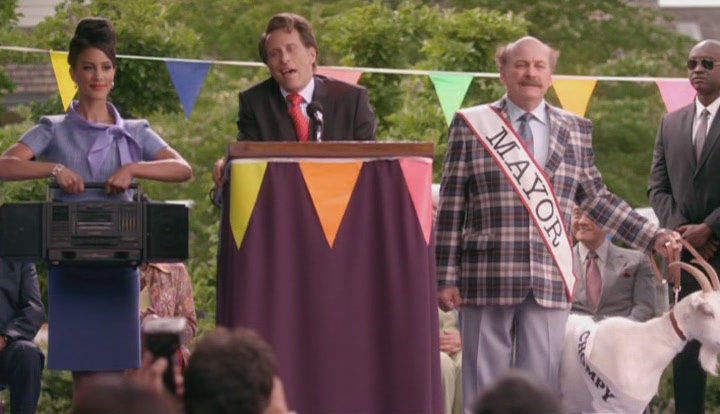
While riding through Dimmsdale park; Timmy is talking to his fairies on the screen of his
smartphone, saying how they'll always be together and that nothing will ever come between them. And in the tradition of the opposite circumstance happening in Fairly Odd Parents; Timmy catches eye of a beautiful young woman. This causes him to lose sight and crash into a mailbox. He follows the young girl to a gathering at town square. The Mayor introduces Hugh J Magnate Jr. (Steven Weber), the villain who is written for this movie. He tells everyone of his intention to bulldoze the park, as it has become abandoned and decayed. He also wants to build an oil well/hotel over it. As you can tell, not only is Hugh an archetype of the evil millionaire tycoon but his plan is representative of people who want to change things for the worst, even though they're fine the way they were. I'll admit it's pretty neat to see the characters that they managed to include, to its credit it does try to make the actors resemble their animated counterparts. But it's not just Trixie who's missing, we don't see older versions of the other supporting characters. I must ask, what happened to Francis? what happened to Dinkleberg? Heck, what happened to Doug Dimmadome? Doug Dimmadome? exactly! I'm not saying that these characters need to have a significant role, but they could have at least given them small cameos like 'The Simpsons' did with their future episodes. Which again, would have worked better had the movie been animated. With that said, Chester and A.J. (Chris Anderson and Jesse Reid) are in this movie too, their role is to simply scoff at Timmy for still acting like a child, and brag about their careers and adult privileges. They like to insist that Timmy is jealous of their quote on quote success when they probably yearn to stay like kids too.

Timmy becomes entranced by the young girl among the crowd. She then speaks up against Magnate in protest. She escapes the security guards by doing an acrobatic flip over the police barrier, and chains herself to the old tree. She claims how it was a part of her childhood, as she's meant to represent the people who want things like they were in the past. Which I must say is a reasonable motive. It turns out that the girl is none other than Tootie, much to Timmy's shock and surprise. That's right, it turns out Tootie grew up into a nature-loving, smart, feisty echo activist. Besides that mailbox, I bet Timmy didn't see that coming either. They go for an 'ugly duckling' plot point, as Timmy once found her obsessive, creepy and overbearing. But after being gone for so long, he now finds her attractive and courageous. Not happy with this, Magnate sends his bulldozers to cut the tree down with Tootie in it. Timmy then wishes for the bulldozers to break down, the chainsaws to turn to balloons and Chompy the town goat to eat Magnate's pants. Timmy goes up to Tootie and they decide to start reacquainting with each other. Overcome with this strange, new feeling, Timmy runs off hesitantly.

Let us talk about Magnate, I've stated how he acts as the antagonist in this movie. Another character trait he has besides being the rich villain archetype is that he never had a proper childhood because he was neglected by his wealthy father. Which reminds me, there was another character from the show with a similar backstory. His name was Remmy Buxaplenty, considering he was Timmy's rival, then Magnate's role should have been given to Remmy instead. If this movie wanted to have a new threat or catalyst, then why not do something that couldn't be done in the show before? I mean, we already had a rich tycoon take over a landmark in Dimmsdale in the show. Anyway, Magnate whines about his plan being foiled, as well as being publicly humiliated. He then gets a phone call from a mysterious voice telling him to meet at the alley, as it has the answers he's looking for. It turns out the "alley' is the name of a Chinese restaurant, that little subversion would have been fine if I didn't see it in 'Tuff Puppy'. Magnate arrives there to meet the mysterious caller, who was Crocker using a voice disguiser. Crocker explains that the incident in the park was caused by Timmy's fairies. Of course, Magnate doesn't believe him at first, until Crooker gives further evidence. He agrees to offer Crocker funding for a 'fairy incarcerator' to harness their magic, which is something I'd imagine Crocker doing now that he has the opportunity. Magnate realises that he could use the fairies' magic for his own use. As they strike a deal, they share a bowl of noodles in which they end up nearly kissing. No homo, the person who first thought of that gag would be proud.
Now the Fairly Odd Parents is well known for its comedy, so how does it work in these movies. More often than not, the jokes here fail to live up to the original series. There might be some joke that can give a chuckle sure, and there're lines of dialogue that I can see would belong in the show. But most of the visual gags are very surface level, without any nuance, often opting for slapstick. The dialogue doesn't have nearly the same tongue in cheek charm, which can also be cliche. What works in a cartoon, doesn't necessarily translate to live-action. Not every joke is awful but there are very awkward moments. In the show, the bizarre scenes and actions always balanced out with good writing, which resulted in a laugh. Here, the quirky moments aren't nearly as sharp. Not even Cosmo, Crocker and Timmy's dad can save the comedy, they're not giving their best material, and they usually have the funniest lines.

The next day, we see Timmy is still thinking about Tootie, he becomes lovesick for her much to the dismay of Cosmo and Wanda. Did I mention that Wanda has a 'love meter', a device that indicates if Timmy is in love or not? And so far, it becomes to get critical. Wanda starts to worry if Timmy really has new feelings for her, which might mean the end of her tenure as his godparent. Tootie comes over, and already Timmy's parents insist that she marry him. They also plan on going abroad when their son eventually leaves them. Timmy tries to avoid her, but she soon catches up to him. Despite Wanda and the other fairies' efforts to keep Tootie from "breaking up their family", she persuades Timmy out on a date. What follows is a romance montage of Timmy and Tootie hitting it off. They go down to the lake and do the typical things to do on a first date, like riding bikes, having a picnic and flying a kite. Meanwhile, Crocker and Magnate spy on Timmy, devising their plans to catch the fairies. As it cuts back and forth to these characters, we get some slapstick humour thrown in there. It's sweet seeing Timmy bond with Tootie, as he learns that she's not so creepy anymore. But if this movie was to add Trixie, here's how I think it would have gone down. It could have had a 'love triangle' approach, so Timmy would have to choose between his fairies, Tootie and Trixie. Why not make it seem like Timmy starts pining for his childhood crush again, but in the end, he realizes who his true love is. It would have made who his heart's desire is more of a twist, it also would have shown the difference between love and infatuation. It also could have their relationship develop through the course of the movie, he's hesitant at first but he learns how special Tootie is. This may seem like a lot to put into a movie that's an hour and 15 minutes long. And I know when writing a story, you have to consolidate all the important characters, ideas and plot points into a cohesive plot. But if they had Magnate replaced with Remi, it could have gone without the assistant character. The movie was originally going to be 90 minutes, so it could have worked.

Which leads me to my next point, the direction. It follows the criteria you expect for a made for TV movie, using very bright, saturated colours. It tries to show what the world of FOP would look like in live-action, trying to evoke the spirit of the series with the use of cartoony sound effects, as well as having Guy Moon do the composition. He still puts the jazzy and zippy tunes to emphasize the mood and character's movements. Throughout Dimmsdale, we see signs that have these big, expressive fonts that make it close to the Butch Hartman world. But here's the thing, what's the point in directing the film like a cartoon, when it could have easily been done in animation? To reiterate, how interesting would it have been to see how Dimmsdale would look like in 10 years time. It could have made references and throwbacks to the show with the buildings and locations. What it does to deviate itself from the show are average settings.....that no one understands. The special effects can get jarring when it tries to emulate the "cartoon" aspect. It doesn't help when they're scenes that have awkward dead space for the characters to faff around. The actors are trying to imitate the character's eccentric personalities but they don't feel natural when set in live-action. They play them off in such an over the top fashion that they're practically chewing up the scenery. It comes off as a big, goofy pantomime. If there's one thing I'll give credit to these movies, is that they don't make Dimmsdale look like the typical futuristic portrayal. It's quite refreshing to see a future that doesn't include sci-fi elements, it's the type of vision that's more likely to happen. Considering the show was made in the 2000s, these movies could take place in the 2010s for all we know. Look at 'Blade Runner' now and it was way off. That way, the devices Crocker uses (like a camera that looks and functions like a dragonfly) stand out all the more

Timmy and Tootie are at a fancy restaurant. Because Timmy lost his pink baseball cap in a kite flying incident, Tootie offers him a new mature looking hat. As you can see, this is supposed to symbolise Timmy's transition to adulthood. As the love meter is quickly rising, Cosmo and Wanda take things to their own hands and transform into a human waiter (Jason Alexander) and waitress (Cheryl Hines). They both disrupt the dinner date by pouring food all over Tootie. What is wrong with Cosmo and Wanda here? Are they just so clingy of Timmy that they'll go along with Timmy's refusal to grow up? I understand Cosmo would do this, but Wanda, she's supposed to be the reasonable one who sets an example for her godchild. But she doesn't act any better. In fact, they're not the only ones who are selfish here, have you notice the other people who are close to Timmy like his parents and ex-friends are towards him. It's not like they want what's best for Timmy, it feels like they want to full fill their own needs. Granted Cosmo and Wanda do get called out for it and they learn their lesson. You may think I'm dwelling on this, but do you think the reason Trixie isn't in this movie because Cosmo and Wanda made it so Timmy wouldn't think of her?

After Timmy tells off Cosmo and Wanda, he wishes Tootie all cleaned up. Timmy brings Tootie to
the park, where he secretly wished for it to be rejuvenated, just like she wanted it. She's happy to see the park gleaming with life, just like it was she was young. Even the local children notice the change and quickly go play in it. It's honestly genuine when Timmy uses his fairies to make a selfless gesture and its no different here. If he was to have that final wish, I would want it to be from the goodness of his heart. You may think Timmy's just doing this to impress Tootie, but how many of us wanted to help out just to be with someone you liked? I think Timmy realises that the cause is a lot more important and satisfying to full fill. And it really seems like this wish would not blow up in his face or that he would be appreciated for it. However, we see Cosmo and Wanda mooting as they watch their dear godchild share a precious moment with another. They reluctantly make the tree bloom with flowers, to enhance the romantic tension. So Timmy and Tootie are sitting in a tree, and just as they're about to start K, I, S, S, I, N, G, Wanda cries out. Causing Timmy to fall over. Tootie flips down from the tree, she begins to suspect that Timmy is hiding something from her (presumably another girlfriend). Since Timmy can't explain to her the situation, Tootie gets upset and runs away from him. Timothy, you're a nincompoop!

As Tootie storms off, she sees a lost rabbit and goes to tend to it. But it turns out to be a trap set up by Magnate, as his bodyguards carry her away, the kids Timmy was hanging out with see Tootie being captured. Tootie is in the limo with Magante, where it turns out he wants Tootie as part of his plan. And the rabbit wasn't just baited, it turns out it was in on the plan too, the rabbit even gives out an evil grin that looks unintentionally frightening. Cosmo and Wanda rejoice until Poof gives them an intense glare that smacks them down to reality. The fairies try to get her back, but they also get caught by Crocker. The kids tell Timmy what happened to Tootie, which seems to be their only purpose in this movie, we don't get to see them afterwards. Timmy wishes Tootie was safe from harm, but a message from the fairies suddenly appears telling him that they were captured. Timmy tries to get his way to Magate's headquarters without magic, he steals a motorcycle to get there much quicker. He bumps into Vickey, causing her to spill some pizza she brought, she then furiously chases after him. Jorgen appears once again, causing Timmy to crash. He gets cornered by both Vickey and Jorgen, but Jorgen accidentally shoots an arrow at Vickey. Making her go Pepe le Pew on Jorgen.


Magnate takes Tootie to his headquarters where he locks her in his subterranean lair. The whole place looks like an indoor playground for children, only much more sinister and twisted. He uses the area to live out the childhood he never had. The set pieces stick out with such intense contrasting colours, but the foreboding shadows and flashing lights make the entire place more menacing. He has Tootie locked in a ball-shaped cage, and Crocker has the fairies locked in the incarcerator. Crocker gives Magante a remote that'll allow him to draw the fairies' magic from them, so he can wish for anything he wants. Magnate tests it out by wishing for a ball pit, this causes the fairies to be painfully electrocuted and their energy sucked out of them. Magnate also makes it bottomless, turning the pit into a wormhole. Just as Crocker thinks he's achieved his life's goal, Magnate betrays him by making Crocker fall into the pit. Meanwhile, Timmy goes to Chester and A.J. asking if they could help him stop Magnate, they question him to which he reveals that he has fairies all this time. They don't believe him at first, but he promises to wish them dates if they help. Back at the lair, Magante has the upper hand having the fairie's power all to himself. He goes mad with it wishing for upper body strength and a large moustache. He turns an action figure he stole from a kid earlier on into a robot servant. And it's at this point where Weber start to revel in his role. We've seen him use overdramatic inflections, but as the plot thickens, he goes more and more insane. You can tell he's hamming it up. He goes from an exaggerated depiction of a rich tycoon to a cartoony villain. The more wishes he makes, the weaker the fairies become.

Timmy, A.J. and Chester get to the headquarters, they break in by simply finding a key under the mat. Just as Timmy gets in, Chester and A.J. leave him behind. No wonder Timmy abandoned these guys. Tootie manages to out of the cage, with Magnate distracted she makes her way across a bridge. Timmy enters the lair, just as Magnate planned. Timmy then duels with the giant robot toy, in a scene that's supposed to be intense while also being slightly humorous, like in the first scene. But I'm just looking at this and it leans more on the silly side, it feels like something you see at a holiday theme park. When you can tell he's fighting an actor in a cheap plastic suit, it takes you out of the moment. Timmy manages to defeat the robot by taking out its batteries. As Tootie is dangling for her life, Timmy swings in and saves her. They see that the fairies have become weak, Magnate has them in a corner, ready to annihilate the two of them. This leaves Timmy no other choice but to make the ultimate sacrifice and act his age. He tells his fairies how much they mean to him, then he confesses his love for Tootie, he proceeds to kiss her. This causes the fairies to slowly vanish and the incarcerator to stop working. With Timmy's fairies gone from his life, Magnate loses his powers and Timmy and Tootie leave him in the dust. So Magnate is defeated and sent to a mental asylum, the assistant changes his company to be more eco-friendly, and Timmy and Tootie are back at the park. They sit by the tree, where Timmy confesses to Tootie about the fairies. He also wishes that he can see them again.
Jorgen appears (while hiding from a lovesick Vicky) and confronts Timmy. Timmy tells Jorgen that he's willing to accept what's coming to him and finally move on to adulthood. But Jorgen actually poofs him and Tootie to Fairy World for a surprise visit. It turns out the fairy council have decided to commemorate Timmy's birthday as a national fairy holiday; as a token of their appreciation for him saving Fairy World on many occasions. With such an honour to his name, Timmy is given the chance to say one final goodbye to his fairies. After Timmy gives a proper introduction to Tootie, he and his fairies give their parting words to each other. Even Poof bids his adieu in a complete sentence. Timmy also managed to find his iconic pink hat. In a truly heartwarming scene, Timmy gives them the hat as a way to remember him, they all proceed to have a tearful group hug. Even Jorgen becomes moved by this, that he cannot bear to tear them apart anymore, but he reluctantly does what he must do. With that emotional farewell, Timmy and Tootie are sent back to earth with their memories of the fairies erased. The following scene shows Timmy ready to continue his life with Tootie. Even though the memories of his magical adventures are fading away, the lessons he learned still rubbed off on him. And with Tootie by his side, the only magic he has is with each other. So they devote their lives to helping other children with their problems. Wherever Cosmo, Wanda and Poof are; they're watching Timmy with such pride as he makes an important step. Thus ending his story.


HAHAHAHAHAHAHAHAHAHAHAHAHAHAHAHAHAHAHAHAHAHAHAHAHAHAHAHAHAHAHAHAHAHAHAHAHAHAHAHAHAHAHAHAHAHAHA! Oh.......oh....oh I Wish!

No instead the Fairy Council have decided based on Timmy's attachment to his fairies and heroism, just stay with me on this. They make a new rule that if any godchild named 'Timmy Turner' kept his fairies for as long as he did and saves Fairy World on multiple occasions, they're allowed to keep their fairy godparents. As long as he make wishes for other people and not for his selfish needs. I'm dead serious, this is how they actually end this stinker. So all that stuff said about having to grow up, was completely in vain. Hohohohoho, you're probably in disbelief like I was. You might also be sick and tired of me comparing this to the show, but at the end of Channel Chasers, it was revealed that Timmy would someday lose his fairies. He would grow up to have children of his own and would leave them with a Vicky robot, just like his parents did to him. So Cosmo and Wanda would, in turn, become the godparents of his kids. To show that history is repeating itself. This scene completely contradicts that! Instead, we get the worse, safest, cheeriest happy ending you can give this story. With Timmy having his fairies back together as an extended family, Timmy decides to start his own business called "Wishful Thinking". With the fairies' magic, they would go around granting wishes for those unfortunate and make the world a better place. But wait, Poof is about to say his first words, and he speaks with the voice of Randy Jackson. Hahaha, in case you've rage quit at the point, or you no longer have any desire to see this, I'll save your trouble of seeing the end for yourself. They fly off in their minivan we see Timmy kept his promise to Chester and A.J. by giving them the girlfriends they wanted. But wait, there's more, we get this epilogue where we see Timmy's Mom and Dad sunbathing in their garden. Suddenly Crocker falls from the sky and walks off dazed and disorientated.

And that was Grow Up Timmy Turner, boy let me tell you, this is fairly bad. It's cheesy, dumb, overbearing, but not in a good way. What could have been a funny coming of age story with mystical and whimsical elements, failed to understand what was special about the original cartoon series. It doesn't know how to utilize its characters, the humour is cliche, any progressive message it might have had was lost in contrivances. If Cosmo giving birth to Poof wasn't the point where Fairly Odd Parents jumped the shark through a giant pair of scissors, then this movie was. For many fans, this was the ending of the fairy tale, the having to face real life and the hardship of maturity. It was where they realised that the show had (for lack of a better term) lost its magic. When it comes to fantasy films, this is a ridiculously pitiful excuse and believe me I've seen some subpar fantasy films lately. I can't even enjoy it in a manner that's so bad it's good. You know I never got why people hate the Star Wars prequels so much, but after seeing this movie, I can completely understand. And that's saying something. This movie would have been better if it was animated, have the characters come off as less selfish, acknowledged the existence of the supporting characters. And furthermore, if it just ended with Timmy leaving his fairies, I would have been fine. It still would have had the same problems, but I would have more respect for it if that's how they ended the series. But the ending we did get really underminds the message it tried to get across, it ruined any chance of the movie having a worthwhile conclusion and solidified my disdain for it.
But what's worse about it, is that it shows that the movie doesn't think that its target audience can cope with the concept of growing up. For any child, one of the hardships in life is reaching the age of reason. Your body goes through changes, life gets harder, and things are not like what you remember them to be. We were told to let go of childhood possessions and at some point, we'll have to move on to bigger pastures. But they're advantages to reaching that certain age too, you could do things you were not been able to do before. With such responsibility in your hands, you can make a difference. Just as long as you stay true to who you are, you can hold on to the childhood memories that you cherish deeply. It's sad when we grow up, but it's for the best that we move on with the times, otherwise, we're stuck in stagnation. But never forget to stay young at heart. This movie doesn't come to that resolution, nor does it want to explore the nuance of it. But rather, it has Timmy have his magic cupcake and eat it too. It doesn't help young viewers come to terms with such an overwhelming concept, and just frames the conflict in an optimistic manner. Thus taking away any tension it might have had. What more can I say about it, chances are my problems with it are the same as your problems. It's not that I was expecting it to be a piece of high art, even the first 5 seasons were hokey and had noticeable problems, but I was expecting it to be as good as the previous TV movies. If you want to see FOP take on the concept of growing up the right way, just watch Channel Chasers, please. Or if you want a modern fantasy film that gives a new spin on fairy tale tropes, just watch the 2007 film adaptation of 'Stardust' instead. I'm just glad this movie wasn't released in theatres, because if it was, then it would have gone down like this.......

If the movie's last third wasn't any indication, then we've only just begun. As this was only the first in Nick's scheme to make a trilogy out of it. Which makes me wonder if Magnate was a caricature of the CEO of Nick the whole time. So what's the next chapter going to be about, that's right it's a Christmas movie........okay then. If the first movie wasn't bad enough they had to make more of them. So I thought the sequel, 'A Fairly Odd Christmas' would be just as cheesy. But I choose to watch it, just to see how they were going to continue this story. Would it be a surprise gift that would be just as good as the first FOP Christmas special, or is it as pleasant as getting coal?

The movie opens with Santa Claus (Donavon Stinson) getting ready for his annual delivery, he has both his nice and naughty lists given to him, but he sees the children's names and wishes are suddenly disappearing from the nice list. He demands to know what could be causing this. Apparently, this phenomenon is caused by non-other than Timmy, we cut to him, Tootie and the fairies travelling all over the world in their van, where they're running their 'Wishful Thinking' organization. He would grant wishes for various unfortunate people, no matter what it is; he would even help two burglars to steal appliances. They make record time making wishes, that they decide to stop off at Dimmsdale.
They catch the attention of Crocker, who is still determined to capture Timmy's fairies. Once again Lewis manages to play off the crackpot role, really embellishing the overdramatic lines with his body language. Crocker runs into the kids from the last movie, saying how he detests the holidays. He claims that all he ever got from Santa was coal, he got so much that he would carry it around with him. He also got handbags from his mother, to which he would respond "Bah-Handbag" as a play on Scrooge's iconic phrase.


I should point out, it was shown that Crocker was once a good thoughtful child; until he lost his fairy
godparents who were Cosmo and Wanda. It could have at least indicated that Crocker has been getting coal since then. But anyway, the kids tell Crocker that he has to be on Santa's nice list to not get coal. Apparently, Crocker doesn't think the North Pole is a real place (despite being a teacher). Get it, he believes in mythical creatures, but not the artic (or even polar bears for that matter). Timmy states how he loves granting wishes for others and doesn't miss making them for his own needs at all. He and Tootie come across Timmy's parents who are dressed as Santa and an elf. They worry if Timmy wants to move back with them, take it from me, there's nothing wrong with living with your parents for the time being. They tell Timmy what they want for Christmas, in the previous FOP Xmas specials, Timmy's dad would obsess over drinking egg nog. But here; he wants a magical pony that poohs ice cream, then it eats the ice cream and poops out gold. Then eats the gold and poops out a motorcycle...........................what the.........................how could you think of something so bizarre? I get that the dad is supposed to be kooky, but this is too bizarre and awkward even for this series. I think these writers had a little too much Christmas ecstasy you think?
After that weird exchange, the gang is confronted by two elves named Dingle Dan (Travis Turner) and Christmas Carol (Devyn Dalton) who demand to speak with Timmy. Cosmo and Wanda start an argument with the elves, apparently, there's this feud between fairies and elves, even though it wasn't a thing in the show. Throughout we see them trading insults at each other, and I thought the movie 'Bright' was on the nose with how it showed prejudice. Fairy lives do matter. And you want to know what this feud is about, well the fairies borrowed a power drill from the elves, they claim the fairies never returned it, even though they did return it. I'm sorry if I spoiled this plot point, but these movies haven't earned my respect. Dan and Carol bring Timmy and the gang to Santa's workshop, where he has it out for Timmy. Unbeknownst to them, Crocker follows the group to the workshop where he plans to get himself off the naughty list.

They arrive at the North Pole, it's at this point where I could see how amateur the quality of these
movies can be. The whole set looks as convincing as a faux Lapland theme park, many of the elves are played by children and at some point, Crocker is chased by a polar bear, but it's obvious that it's a man in a suit. The interior of Santa's workshop is certainly lavish for the movie's criteria. We see how the preparations work, like many modern Santa based films, the factory is depicted to use modern machinery. Timmy and the gang are greeted by the jolly fat man himself, Santa Claus. Stinson by no means does a bad job as their version of Santa, but I'm more used to Kevin Michael Richardson's vocal portrayal from the show. As Timmy gets reacquainted with Santa; he discusses to Timmy that by granting the world's wishes, they're already being fulfilled, so they don't need him anymore. Thus putting the jolly fat man and the elves out of work (and possibly other fairies as well). This isn't the first time Timmy has put Christmas at stake, as this is honestly a lot like the previous Christmas episode, 'Merry Wishmas'. Timmy apologizes and Santa gives him two candy canes, saying that they're useful for getting anyone out of a rough spot. Gee, I wonder if this is foreshadowing a later scene. Meanwhile, Crocker sneaks in through an open window and disguises himself as an elf. However one of the elves catches Crocker, figuring he's a new employee, Crocker is put through the wringer as he has his ears sharpened to look pointy. Yikes! Crocker is put on reindeer duty, as he has to muck out the stalls while shovelling he notices how the reindeer's pooh sparkles like gemstones. Okay, what is with the toilet humour in these movies, yes the first 5 seasons did use these types of jokes on the rare occasion, but they were done in a way that somewhat made the young viewer think. I mean, I'm not above making those kind of jokes, so long as they're done well. Here it's just using it for the sake of it. Crocker mistakenly lets the reindeer out, causing them to run loose.

Just then, one of the toy-making machines gets jammed, as Santa goes to fix the problem he wishes
he could stop it from breaking down. Timmy gets the idea to grant Santa's request, even though he may get it under control. The fairies use their magic, however, because they're in an elf made building, the wish malfunctions causing Santa to fall into the machine. They find Santa all wrapped up, he is shown to have serious amnesia. To make matters worse the whole workshop shuts down, as a result, Timothy, you're a nincompoop! In this state, Santa starts to act out multiple personalities. Did I mention, there's this machine that generates all Christmas spirit and joy around the world. Which is also affected. Jorgen appears, he has Timmy temporarily assume Santa's responsibilities, for it is written in Da Rules that a godchild must take over the role of a holiday icon if he/she has harmed them to the extent that they can't perform their job. So this movie is going for 'The Santa Clause' plot. Timmy puts on Santa's hat and it seems to get the whole place working again, but things go haywire again. One of the elves explains that Timmy cannot be Santa because he has gotten himself on the Naughty List. Timmy figures he could wish himself out of the list, but the fairies are unable to do anything. Without the Christmas spirit power being degenerated, there's some force about the North Pole's magnetic polarity rendering the fairy magic useless. Wasn't it revealed in the show's first Christmas episode that most of the fairies' magic was transferred to Santa every Christmas Eve? So how could he be in a building that prevents fairy magic, if he needs it in the first place? It just doesn't add up. The elves explain to Timmy that he can get himself off the Naughty list by confronting Elmer, the elder elf (Tony Cox) who's in charge of determining who belongs on said list. Despite it being a difficult task Timmy is willing to do it in the name of Christmas. Tootie and the fairies agree to tag along too, Crocker reveals himself and wants to join them so he can remove his name off the list too.

Timmy and the gang begin their journey, bringing Dave and Carol to guide them, though it becomes apparent they both don't exactly know the way. They also keep arguing with the fairies. They come across perilous obstacles that were made to be Christmas themed. For example, they come across a chasm of razor-sharp candy cane spikes. But the environment is still nothing interesting to look at. They get past the chasm using a zip line, but of course, whatever can go possibly wrong, does go wrong. Suddenly the ground cracks from underneath, causing Timmy and Crocker to get separated from the rest of the group. By having all these characters together, it makes sense to have them split up. The fairies, elves, and Tootie get themselves in a forest where they come across a penguin; even though penguins don't live in the North Pole. Look I don't expect realism from these movies, but if they're going to throw out logic, it has to make sense within its own world. That inaccuracy aside, Tootie with her experience with animals asks the penguin to help them find the others. Like that. She manages to communicate in penguin speech, it does not know where to find them but it knows a way out of the forest. In the most unlikely pairings, Timmy and Crocker meet a group of large sentient Gingerbread men. Not only is their CGI cheap, but they have a child-friendly demeanour. What was distinctive about the original show is how it gave a contemporary spin on such mythical beings, even Santa and his organization was that way. Aside from the advanced technology, the workshop is no different from other variations. However, they don't play this nature straight, as Crocker bites the head off one of the gingerbread men out of hunger. This dark turn juxtaposes with their exchange, as it infuriates the gingerbread enough to kill them both. So Timmy and Crocker run, run as fast as they can, they cannot be caught by the gingerbread men! Speaking of which, the fairies and elves put aside their differences to fend off the gingerbread with show balls, and I notice how obviously the footage is sped up. The poor effects just make this sequence all the more anarchic.


So after that madness, the group sets up a camp for the night. Timmy has trouble starting a fire until Crocker lends his Christmas coal. Throughout this movie, Crocker starts to show more kindness. If they really wanted to end Crocker's arc, they would have gone somewhere by redeeming him. It would be justified considering how he became evil. The elves and the fairies start to bond with marshmallows and learn to get along as well. Without their magic, the fairies serve very little purpose until the last minute. Back at Santa's workshop, Jorgen is still helping Santa recover, who is still as nuttier and mixed up as a fruitcake. But the elves notice that they're are running low on Christmas spirit. A green cloud of gloom appears, and we see it take its effect on the people of Dimmsdale. We see Timmy's parents having pie, they burst into tears and Timmy's Dad's face is smeared with pie. A group of children are making paper decorations, overcome with grift one of them makes a collage of 'The Scream'? A group of carollers become depressed, the only person who isn't affected is Vickey, she's given the opposite effect because of course. The next day, Timmy and company reach a rickety bridge over a river of egg-nog. I for one have never tried egg-nog before, but I doubt it would be as molten as shown here. They cross over immediately when they see the vengeful gingerbread men coming after them. Once again, the fairies take them out with snowballs, but one gingerbread man cuts a rope holding the bridge. Just as Timmy helps Crocker get across, he falls off the cliff. Gasp, could it be that Timmy is gone? No, of course not, he climbed his way back up using the two candy canes he got earlier. Why do I have this uncomfortable feeling that this is going to be common?

The gang finally make it to Elmer's lair, after going down a trapdoor, knocking over a toothpick sculptor of the Eiffel tower, they come face to face with the elder elf. He's supposed to be an all-knowing being with an ominous presence, only Tony Cox portrays him using back sass. It's too bad Cox is synonymous for his role in the infamous Seltzerberg parody movies. The only joke I remember from him is one involving his toothpick sculptor. I'd say that they got Cox because they couldn't get Peter Dinklage, but I think he'd be too good for this. Timmy asks if he could be taken off the Naughty List. Elmer explains that even though Timmy has been using magic to make good gestures, it's technically the fairies doing the work. He also explains that despite Timmy's intentions, he's still making reckless wishes without thinking about the consequences. He proves this showing videos of the results of Wishful Thinking', as we're treated to images of children in and/or causing distress, including his recent mistake with Santa. So the moral of this story is that with great power comes great responsibility, which they make abundantly clear at certain points. It shows that no matter how much older and wiser Timmy becomes, he'll continue to make similar mistakes. For this, Elmer refuses to take Timmy and Crocker off the list. With everyone left with no hope, Timmy apologizes for his errors, but Tootie and his fairies are still proud of him for trying. Even Crocker of all people starts to show his newfound respect for Timmy, I bet none of you saw that coming did you? Elmer overhears Crocker's supportive speech and is impressed that Timmy was able to give Crocker a change of heart. So he removes Timmy from the Naughty list and allows the group to use his own vehicle back to Santa.

After they make it back, Timmy gets into Santa's suit thus bringing full power back to the workshop. As he gets things running in order, they only have an hour to prepare everything to avoid the cloud of gloom covering their path. Timmy manages to motivate everyone to work without magic, even Jorgen is willing to assist them. So we get a musical montage of everyone making the presents set to a cover of 'Santa Claus is Coming to Town'. The only funny thing is how in the episode 'Christmas Everyday', they didn't use the song 'I Wish It Could Be Christmas Everyday' by Wizzard; yet Nick would have the rights to use that song. Anyway, they managed to set up the sleigh on time, but the reindeer are still missing. For all the things Crocker has done to help, he's still trouble even when he's not the antagonist here. Luckily the fairies somehow manage to bring the Wishful Thinking van, with Jorgen and them behind the wheel, Timmy takes off on the sleigh with the aid of his sweetheart and long-time enemy. Just when you think Timmy can get a lot accomplished without the aid of his fairies, they come in to save the day. They just make it out of the fog of gloom before it closes. With everyone on his side, Timmy successfully delivers all the presents to everyone (even fulfilling his parent's wishes). On Christmas morning, Santa now having recovered from his amnesia is surprised to see his work taken care of for him. So everyone celebrates Timmy's job well done, Crocker is given the first real present that anyone has ever given him. Dave and Carol make amends with Cosmo, Wanda, and Poof for helping them save Christmas. The fairies clear up the whole misunderstanding with the drill, and Timmy kisses Tooty underneath the mistletoe. Poof then gives a traditional Christmas phrase, and Cosmo and Wanda ensure everyone that no fairies were harmed in the making of this movie. Like we never heard that joke before? Just to top of this mangled tree, we also end this off with another poop joke with the pony.
Overall, A Fairly Odd Christmas still has the same cheap effects, oddball acting and predictable
humour wrapped up in one package. With that said, it's isn't remarkably bad like the first one. Whereas with the first one I was somewhat expecting it to be decent, with this one, I knew it wouldn't be good and I got what I expected. At least the first one was memorable in its failure, but the sequel was just dull and wasn't all that imaginative. I mean it was still stupid, but that's to be expected. If there's any purpose for this movie's existence, it's to show that Timmy still has his shortcomings even as an adult and to show Crocker have a redemption as a character. I suppose I'll give it credit for showing the holidays can be a time for enemies to put aside their quarrel for the sake of what's right. And I suppose it isn't anything to get mad at, though it still has its awkward moments. But still, it captures everything chintzy and artificial about the holidays. I guess I won't stop you from seeing how this compares to the first one, but you're better off watching the FOP episode 'Christmas Everyday'. You can't go wrong with watching that around the holiday season. But Fairly Odd Christmas is one movie that won't be on my list to watch during this time.
It's all come down to this, A Fairly Odd Summer, the third and final movie in the series. You may have noticed that these sequels take place during a different season, first Christmas then Summer. Okay, if these wanted to be thematic, then couldn't they each take place during different points in Timmy's adulthood? Anyway, when I first heard this was being released, I was not looking forward to it at all. I basically had no strong feelings one way or the other. But I decided to watch it anyway, just so I can put this trilogy into perspective. Maybe I wanted to give this one the benefit of the doubt, but I knew better not to expect any FOP live-action movie to be of better quality. And considering the director has done a summer movie before, it figures he applies that to his version as well. Let us examine the case for 'A Fairly Odd Summer' and see how low this series can go just so we can get this over with.

It begins with Timmy in a tropical rainforest where he hears Cosmo, Wanda and Poof are in danger. He gets hunted down by masked primitives. Running away from them, Timmy suddenly ends up inside a volcano. Only for them to find him. He finds the fairies trapped hanging by a rope, it turns out to be a plan by Crocker who threatens to drop them into the lava. That is until Tootie comes in and resues the fairies. They manage to escape Crocker's clutches, as the volcano begins erupting. The opening scene is quite a thrilling sequence, it has the right amount of action, suspense, and silliness, which makes it akin to a scene from an Indiana Jones film (the fourth one that is). They make it off the island on a jet ski, Timmy and Tootie kiss. But it turns out it's Timmy having a dream, even though this sequence could easily take place in the movie's reality. When it comes to these movies, the best thing to do is.......

We see that Timmy now works a summer job at Fairy World's 'yuck disposal system'. I suppose his 'Wishful Thinking' organization was a bust. Apparently, Jorgen got Timmy this job so he would be
able to work for a living, which the fairies agree upon. Timmy also wanted to impress Tootie who has a summer job of her own, but he's upset that he won't be able to enjoy his summer. He finds it tedious and that it doesn't feel right for him. Especially when he doesn't have much prior work experience or a college education. He starts to yearn for his carefree days. We see the live-action version of Fairly World and it looks so garish. They tried to recreate how it looked in the cartoon with strong textures and lighting, but what holds it back is how the set pieces are tacked on. It just looks uneven. Also, the rendering on the fairies in the background looks awful. The models don't blend with the backdrop and they don't even have the Hartman design. It looks like the background of a cheap Troublemaker Studios kids film mixed with characters from 'Foodfight' (and I'm not talking about the season 7 episode). He pops into Dimmsdale to see his girlfriend at the animal research centre. He also meets the scientist she works for, whose main joke is that his name is "Butterfarts", and they beat these flatulence jokes into the ground. It turns out that Butterfarts made a gas formula that will cure a species of dolphins, and Tootie has to deliver the vial that contains the gas to the research team in Hawaii. Tootie tells Timmy she'll be there all summer, much to Timmy's chagrin. Timmy learns that his parents just so happening to go to Hawaii too because the pencil company Timmy's dad works for chose it for their summer retreat. Timmy's dad was also put in charge of providing a fire dance and is given a lot of money to do so. And his job is on the line if he messes it up.
There's also this subplot with two children named Marty and Mitzy (Carter Hastings and Ella Anderson), who come from a rich family. It just so happens they're going to Hawaii as well. They're looking forward to this holiday, as they hardly ever get to spend time with their parents. Which also reminds me of Remy Buxaplenty. That is until the parents become too busy yet again, so they are unable to go with them. But the parents leave the two kids in the care of Vicky, who you know would definitely accept the job and payment. It sets up that the kids will have fairies of their own by the end, however, these two don't leave enough of an impression. I suppose I can't blame the actors but you can barely tell them apart.

Back at Fairy World, Jorgen leaves Timmy to take over his position, while he enters a strong man contest that just happens to be to Hawaii. Timmy is put in charge of guarding the source of all magic, an element known as 'Abracadraium'. Which I'm convinced was written specifically just for this movie, yet Jorgen builds it up as an important McGuffin. I'm starting to question which aspects of the fairy lore should be explained, and which should be left vague. Say what you will about seasons 7-8, one of the good aspects about them is how they tried to expand the world-building. Some worked well, others were misguided. But do we want to know what the magic is made from, do we want to know how long time goes in Fairy World? Foop is spying on the unknowing Timmy. For those who stopped watching FOP, Foop was the anti-fairy version of Poof, he was also his enemy. His character trait has been called a kid-friendly version of Stewie Griffin, but I didn't mind whenever he was there (for the most part). But he soon wore out his welcome. Being the youngest villain the show ever had, Foop tries to prove his worth to the council of Anti-Fairies. He proposes to destroy the Abracadraium. They allow him to take on the task, on the condition they take his bottle from him (which is the source of his powers). They warn Foop that the magical element is also their fatal weakness and that if he fails then he'll face an unspeakable horror. Whilst having lunch, Timmy discovers he has the check for the celebrations and the gas vial which was mistaken for his lip balm. So what's Timmy going to do? He has to bring these items to Hawaii, but he can't leave the Abracadraium. He decides to take it with him, even though removing it will destroy all of Fairy World. Luckily the Big Wand that powers Fairy World has backup power to run it temporarily. Timmy puts the magical element in a carrier bag (putting all magic at risk) and fly over with the magic van, unaware that Foop is on their tail.

Crocker is at the Hawaiian airport, where his mother registered him on a rehabilitation retreat with other insane mental patients. We see one of the patients is played by Butch Hartman, did I forgot to mention that Butch plays a different character in each one of these movies. I'm convinced that Butch is off his rocker here, and I'm not talking about his character. Crocker crosses paths with Foop, who crash-landed there. They appear to have forgotten each other, considering they did team up before. After the other mental patients get freaked out by Foop, Crocker reverts to his evil self and they initiate their diabolical scheme. Timmy's Mom and Dad are at the resort where Timmy's dad's boss Ed Leadly reminds him he's in charge of the festivities. Just when Timmy's dad is in hot lava, Timmy comes in and saves his bacon. He finds Tootie to give her the dolphin cure, albeit slightly late. Timmy thinks because they're in such a beautiful tropical location, he decides to take a break with Tootie and the fairies and enjoy themselves. There's this notion that actors and directors film at sunny islands just as an excuse to have a holiday, rather than using the location to tell a story. I don't know if that was the case, but it definitely feels that way. Foop and Crocker are inside a dark, foreboding cave where they discover they can summon molten lava using the moonlight. This ancient ritual along with the tiki statues add mysticism to the island. Foop thinks this will be the place to destroy the magical element. While Timmy and Tooty are having fun in the sun, Foop and Crocker try to get their hands on the carrier bag using cliche cartoon antics. Such as shooting a sleeping bug at him or digging a pit with a tiger underneath a beach blanket. Only for Crocker to get foiled in a comical fashion.

We cut back to Marty and Mitzy, where throughout the holiday Vicky continually mistreats them. They manage to comically escape her clutches with a sandcastle and spend time in the pool. They cross paths with Timmy and Tootie, unfortunately, Vicky finds them both. She and Tootie don't even acknowledge they're sisters. I mean it's not a necessary detail, but surely this movie could show how Vicky would react to her sibling dating Timmy? (someone who she had a vendetta with since they were young). Timmy helps the kids where they'll be hoping Vicky gets hit with cake by the ocean. Foop changes his form to an adult human (Scott Baio), he and Crocker are meet by Timmy's parents who mistakenly give them the money for the festivities. This gives Crocker an idea to disguise themselves as island natives, with Foop as a monkey. You think if the Crimson Chin was in these movies, you think the director would have put him in a sailor suit? They distract the pair by dancing to a 90s jam..........I don't even know what I'm watching anymore! They realized that they've been tricked but the bag with the Abracadabrium has been stolen, thus putting Fairy World and it's inhabitants in danger. Say it with me now, Timothy, YOU'RE A NINCOMPOOP! Jorgen spots Timmy and becomes enraged when he learns what happened to the magical element, he's more furious than we've ever seen him that his skin changes colour. The judges of the strong man contest notices this and are impressed. By this point, I think many of the older are feeling frustrated.

Seeking the element back, the pair and the fairies recruit Marty and Mitzy to help. Cosmo believes Timmy left the Abracadaium in his parent's hotel room, so he poofs himself there with Wanda and Poof. They get themselves stuck in the fridge, and they lose their magic again. While Timmy looks for the Abracadabraium, Tooty and kids chase Crocker and Foop (who are riding on a cart shaped like a pineapple). These characters are getting too old for this, and so am I. The fairies get themselves out of the fridge, but their powers are weakening without their power source. When Timmy finds them, he realises what a mistake he's made. Just as the moon rises, our villains make it to the cave to summon the lava. Just as Crocker is about to destroy the Abracadabrium, he becomes affected by the element's pure magic. Tooty comes into the scene with the kids tagging along with her, they see Crocker turned good that he doesn't want to take the plan into action anymore. Angered by this, Foop risks touching the substance to do it himself. But Timmy comes in a tries to negotiate but to no avail. We reach our climax, Foop tries to destroy everyone with a swinging rock, but Timmy uses it to get the magical element and saves everyone in the process. Timmy and Foop battle over the element until Timmy falls into the lava with it. Jesus Christ, that took a dark turn! I cannot believe they would end the trilogy on such a morbid note.
As if they would ever end it like that, because if you thought the ending to the first movie was a big slap in the face, then you better be sitting down for this one. Just when you thought these movies couldn't get any stupider, Timmy manages to survive the lava, he rises with the Abracadabrium still intact and becomes a fairy. Your eyes aren't fooling you, what you're seeing is real. Because the heat made him absorbed some of it's magic, Timmy is turned into an animated fairy with his younger form and voiced by Tara Strong herself. This is what they've been building up to people, first, he essentially went above fairy law, temporarily filled in the position of Saint Nick and now he's ascended to be a divine powerful figure. Despite the fact he's screwed up during this trilogy, he now has the powers of a God. I'm speechless, I really am. You know, they could have found a way to tie these movies with the ending of Channel Chasers, but no, they still managed to contradict it even further. Do these movies even exist in the same timeline? I'm just flabbergasted that they went this direction, shocked even. After watching this movie, I felt unclean, it only furthered the existential dilemma I was having. It made me want to look at the mirror and just wonder how it came to this. So Crocker returns to normal (in the loosest sense), Foop is defeated and Jorgen reassigns the fairies to the two kids. And they didn't do this in the first place? Even Timmy can now visit the fairies on meetings. With his new fairy powers, Timmy creates the fire dance for the Pencil company event, with Crocker involved. It becomes a success, which is more than I can say for this picture. Marty and Mitzy are delighted in having fairies, by turning Vicky into a rabbit. Tootie wonders how she's going to adjust to Timmy as a fairy, which makes me wonder too, are fairies even allowed to have romantic relationships with mortals? The movie closes out with fireworks and everyone getting their "happily ever after", except Foop who is sent down the drain of the yuck disposal system where he presumably dies.
*phew*, Thank God Parents this is over. A Fairly Odd Summer, more like a Fairly Odd Bummer! A lot from the previous two films carries over to this one, only it manages to be more stupid and over the top than before. It puts our characters together for sheer plot convenience, yet we've given so much filler and gags we could see coming. It's hard to take in the tropical scenery with all this lunacy. Not even Crocker in all his craziness could save this. I think this might be the worst of the three, just for that baffling ending alone. Had the first movie ended with Timmy saying farewell to his fairies, passing them down to a new generation of godchildren would have been more gratifying. It would have been an appropriate epilogue while Timmy finds his calling. But they had to give him fairy powers of his own, was this really necessary? Channel Chasers gave us a perfectly suitable conclusion to Timmy's story, so why change it? It might be the dumbest thing the franchise ever pulled off, you have to marvel at it, and just how it attempts to be "epic". This is not what the fans wanted and chances are it wouldn't satisfy anyone else. This is the worst possible way they could cap off this series, it's a worse ending than the one for 'Game of Thrones', that's right I went there. If you really want to see how mad it truly is, go ahead and be my guest. But please be warned, as it'll drive you coconuts. You'll have as much enjoyment from a sunburn. With that, I would like to apologize to the people of Hawaii on behalf of everyone who worked on this. I think we all need a holiday after this mess.
Bottom line; I think the Fairly Odd Movies fail to capture the magic and charm of the original cartoon series. The stories are either wasted potential or misguided even, the production values are camp, the acting is ham and cheese, the humour isn't nearly as funny or subtle and the same goes for the characters they choose. These movies are certainly odd, but not in a good way. Each one manages to have their own bad traits to distinguish them. Nothing is funny or enchanting, they may have had good intentions but the stories and characters weren't handled well. They didn't really need to be live-action or be a trilogy or have Timmy become a fairy. Even if they were made by the best filmmakers, the scripts would still be nonsense. They try to appear like the cartoon, but they don't feel right. What it does to make it different from the show just falls flat. The fact that they're about Timmy holding onto his fairies for far longer than he should have is a befitting metaphor to describe what happened to the series. As Nick kept the Fairly Odd Parents going on and on, instead of letting it end while it still had dignity. Until they decided to unceremoniously put it out of it's misery. It got to the point where the show's last season felt more like a spinoff rather than a continuation. As movies by themselves, they're corny stories about a young man who never grew up and he would be attached to his magical friends. Only for him to start taking responsibility and eventually follow in those beings' footsteps. They contain many exasperating traits found in bad family movies. If there's any reason to watch these movies, it's to analyze how not to do an adaptation or a follow-up. They made me do the unthinkable, they made me wonder if the Fairly Odd Parents was ever even good in the first place.
Considering this is one of those cases where the original creator screwed up with their own source material, you gotta wonder. Did Butch Hartman lose his touch, or was he never talented to begin with? Was the reason why the show worked before because there were other people involved? Would the show have been different if he had his own way back then? Did Butch always want to end it this way? Were there too many yes men? Was it creative differences with the director, or was it Nick interfering with the script? We could only wish to know. That said, it's actually intriguing how this guy managed to make his dreams and these changes become realised without anyone standing in his way. It just so happens they're not very good. If you feel these movies "ruined your childhood", then your childhood wasn't all that special. Any kid who watches these will probably grow up to realise the previous FOP movies were a lot better. And if you're one of those people who does enjoy these movies as much as the show, I have nothing against you. If you could see more positives that I and other fans cannot just share with me the reasons why you enjoy them. I'm not in any position to judge.

I'm going to take a dose of F***ital. Oh, and to Butch Hartman, Savage Steve and any executives from Nick. If somehow you're reading this, if this is how you want to represent or cap off such a funny cartoon, then you've tarnished it's legacy. And if you're not listening to my criticism, or you're not interested, then here's a picture of a hand, please talk to it.